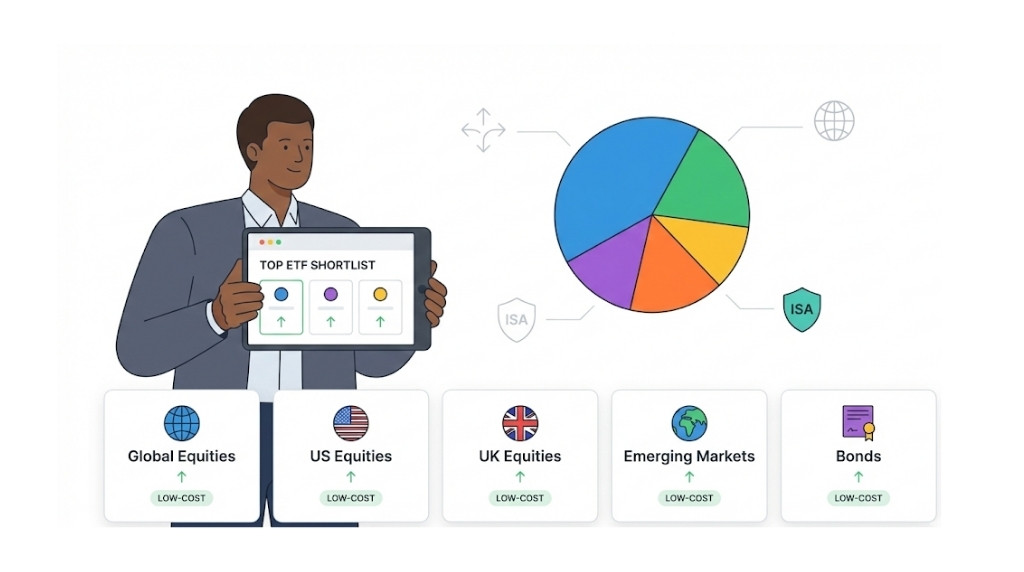
Looking for the best ETF in the UK? For most investors, the best ETF is usually a low-cost global tracker such as Vanguard FTSE All-World (VWRP or VWRL) or iShares Core MSCI World (SWDA). These funds give you broad diversification in a single investment and can work well inside a Stocks and Shares ISA for long-term, tax-efficient growth.
This guide compares the best ETFs for UK investors in 2026, including the best global ETFs, best accumulating ETFs for ISAs, and popular options for US, UK, bond and emerging markets exposure. We focus on low costs, diversification, liquidity and ease of use, so you can find the right ETF for your portfolio.
For many beginners, a single global ETF is enough. More advanced investors may want to add a UK ETF, bond ETF or emerging markets ETF to tailor their portfolio more precisely.
ETFs have become one of the simplest and cheapest ways for UK investors to build a diversified portfolio. Instead of trying to pick individual shares, you can buy a single ETF that tracks a whole market, sector or index. That makes ETFs a popular choice for beginners, long-term investors and anyone investing through a Stocks and Shares ISA or SIPP.
For most people, the most useful starting point is a global equity ETF. Funds such as Vanguard FTSE All-World and iShares Core MSCI World give you exposure to hundreds or thousands of companies in one investment. From there, you can decide whether you want to keep things simple with one core ETF or add specialist funds such as UK, bond, S&P 500 or emerging markets ETFs.
In this guide, we compare the best ETFs for UK investors in 2026, explain how to choose between accumulating and distributing ETFs, and highlight which options may suit beginners, ISA investors and long-term monthly investing.
Warning: Past performance is not a reliable indicator of future results. All investments carry risk and you may get back less than you invest. The ETFs listed below are for informational purposes only and are not personal recommendations.
Best ETFs for UK Investors: Our Top Picks
Best ETFs for UK Investors
| ETF Name | Ticker | Index | OCF | Type | Best For |
|---|---|---|---|---|---|
| Vanguard FTSE All-World | VWRP / VWRL | FTSE All-World | 0.22% | Acc / Dist | Core global holding |
| iShares Core MSCI World | SWDA | MSCI World | 0.20% | Acc | Developed markets |
| Vanguard S&P 500 | VUAG / VUSA | S&P 500 | 0.07% | Acc / Dist | US large-cap |
| iShares Core FTSE 100 | ISF | FTSE 100 | 0.07% | Dist | UK large-cap |
| Vanguard FTSE 250 | VMID | FTSE 250 | 0.10% | Dist | UK mid-cap |
| Vanguard FTSE Emerging Markets | VFEM | FTSE Emerging Markets | 0.22% | Dist | Emerging markets |
| iShares Core UK Gilts | IGLT | UK gilts | 0.07% | Dist | UK government bonds |
| Invesco NASDAQ-100 | EQQQ | NASDAQ-100 | 0.30% | Dist | US tech exposure |
| Vanguard FTSE Dev. World ex-UK | VHVG | FTSE Dev. World ex-UK | 0.12% | Acc | Global ex-UK |
| SPDR MSCI World Small Cap | WOSC | MSCI World Small Cap | 0.45% | Acc | Global small-cap |
Best Global Equity ETFs
Vanguard FTSE All-World (VWRP/VWRL)
This is the single most popular ETF for UK investors seeking global diversification. It holds over 3,700 companies across developed and emerging markets, covering approximately 98% of the investable global stock market. The accumulating version (VWRP) reinvests dividends automatically, making it ideal for long-term growth inside an ISA.
OCF: 0.22%. The fund is domiciled in Ireland (UCITS) and trades on the London Stock Exchange in GBP. It includes both large and mid-cap stocks, weighted by market capitalisation (Source: Vanguard, 2026).
iShares Core MSCI World (SWDA)
An alternative global tracker from BlackRock's iShares range. It holds around 1,400 companies from developed markets only (no emerging markets). At 0.20% OCF, it is slightly cheaper than Vanguard FTSE All-World but less comprehensive. Pair it with an emerging markets ETF for full global coverage.
Best US Equity ETFs
Vanguard S&P 500 (VUAG/VUSA)
Tracks the 500 largest US companies and is the most popular single-country ETF among UK investors. The S&P 500 has delivered an average annual return of approximately 10.26% since 1957 (Source: IG, December 2024). At just 0.07% OCF, this is one of the cheapest ETFs available. VUAG is the accumulating version, VUSA distributes dividends.
See our full guide: How to Invest in the S&P 500 UK.
Invesco NASDAQ-100 (EQQQ)
Tracks the 100 largest non-financial companies on the NASDAQ exchange, giving heavy weighting to technology giants like Apple, Microsoft, Nvidia, Amazon and Meta. Higher risk than a broad S&P 500 tracker due to tech concentration, but potentially higher growth in technology-driven markets. OCF: 0.30%.
Best UK Equity ETFs
iShares Core FTSE 100 (ISF)
The largest and most liquid FTSE 100 ETF, holding all 100 companies in the UK's blue-chip index. Very low OCF at 0.07%. The FTSE 100 provides exposure to globally diversified UK companies, with significant revenue from international markets. Good for income investors, as many FTSE 100 companies pay substantial dividends.
Vanguard FTSE 250 (VMID)
Tracks the 250 mid-cap UK companies ranked just below the FTSE 100. These tend to be more domestically focused than FTSE 100 companies and can offer higher growth potential. Historically, the FTSE 250 has outperformed the FTSE 100 over long periods, although with greater volatility (Source: FTSE Russell). OCF: 0.10%.
Best Bond ETFs
iShares Core UK Gilts (IGLT)
Holds UK government bonds (gilts) across all maturities. Gilts are considered very low risk because they are backed by the UK government. Bond ETFs provide stability and diversification when held alongside equity ETFs. Particularly useful for investors approaching retirement or those wanting a more conservative allocation. OCF: 0.07%.
Best Emerging Markets ETFs
Vanguard FTSE Emerging Markets (VFEM)
Provides exposure to large and mid-cap companies across emerging markets including China, India, Taiwan, Brazil and South Korea. Emerging markets offer higher growth potential but also higher volatility and political risk. OCF: 0.22%. Consider this as a satellite holding alongside a core developed markets ETF.
Key takeaway: For most UK investors, a single global ETF such as Vanguard FTSE All-World (VWRP or VWRL) is a strong starting point because it offers broad diversification in one fund. If you want lower cost developed-market exposure, iShares Core MSCI World (SWDA) is another popular choice, although it does not include emerging markets. As your portfolio grows, you may decide to add UK, bond or emerging markets ETFs to build a more tailored allocation.
How We Selected These ETFs
We selected these ETFs using the factors that matter most to UK investors:
- Low cost: We prioritised ETFs with competitive ongoing charges.
- Diversification: We favoured broad, well-diversified funds for core holdings.
- Liquidity and size: We focused on established ETFs with strong trading volume and significant assets.
- UCITS structure: We prioritised UCITS ETFs suitable for UK investors.
- LSE availability: We focused on ETFs available on major UK investment platforms and traded on the London Stock Exchange.
- Practical use: We considered whether each ETF works well as a core holding, satellite holding, ISA investment or long-term monthly investment.
Where to Buy These ETFs
Most of the ETFs in this guide are available on major UK investment platforms. The right platform depends on what you want to invest in, how often you trade and how much you have invested.
Popular options include:
- InvestEngine: Strong choice for ETF-focused investors looking for low platform costs
- Trading 212: Commission-free ETF investing with fractional shares
- Vanguard: Simple option for investors who only want Vanguard funds and ETFs
For a full comparison of fees, features and platform options, see our guide to the best trading platforms in the UK.
Frequently Asked Questions
Vanguard FTSE All-World (VWRP) is widely considered the best single ETF for beginners. It provides global diversification across over 3,700 companies in developed and emerging markets at a low 0.22% OCF.
One global equity ETF is enough for most beginners. As your portfolio grows, you might add a bond ETF for stability or a UK-focused ETF for home market exposure. Most investors need no more than three to five ETFs.
Accumulating ETFs reinvest dividends automatically, which is ideal for long-term growth. Distributing ETFs pay dividends as cash, suitable for income investors. Inside an ISA, there is no tax difference between the two.
Both track the same indices and offer similar returns. ETFs trade like shares on the stock exchange, while index funds are bought directly from the provider at a once-daily price. ETFs sometimes have marginally lower costs. The choice depends on your platform and preference.
Yes. Holding ETFs inside a stocks and shares ISA means all gains and income are tax-free. This is the most common and tax-efficient way to invest in ETFs in the UK.
OCF stands for Ongoing Charges Figure. It is the annual cost of running the ETF, expressed as a percentage of your investment. An OCF of 0.07% means you pay 70p per year for every £1,000 invested. It is deducted from the fund value, not charged separately.
Many ETFs receive dividends from the companies they hold. Distributing ETFs pass these on to you (usually quarterly). Accumulating ETFs reinvest them into the fund. Inside an ISA, all ETF dividends are tax-free.
No. UK stamp duty does not apply to ETF purchases. This is an advantage over buying individual UK-listed shares, which attract 0.5% stamp duty reserve tax.
HSBC FTSE All-World Index (HMWO) at 0.13% OCF and Invesco FTSE All-World at 0.15% are among the cheapest global trackers. Vanguard FTSE All-World (VWRP) at 0.22% remains the most popular due to its size and liquidity.
Yes. Most platforms offer regular investing plans for ETFs. Some waive dealing fees for monthly contributions, making pound cost averaging cheap and convenient.
Conclusion
The best ETF in the UK depends on what you want your portfolio to do. For most investors, a low-cost global ETF such as Vanguard FTSE All-World or iShares Core MSCI World is the most sensible starting point because it offers wide diversification in a single fund. Investors who want more targeted exposure may prefer ETFs focused on the S&P 500, the UK market, bonds or emerging markets.
If you are investing through a Stocks and Shares ISA, it can also make sense to think about whether you want an accumulating ETF that reinvests dividends automatically, or a distributing ETF that pays income out. In many cases, keeping things simple with one or two broad, low-cost ETFs is more effective than building an overly complicated portfolio.
Before investing, compare the ETF’s charges, index, fund size, distribution type and how it fits with your overall asset allocation.
Related Reading
Explore more investing guides on Smart Investor UK:
- How to Buy ETFs UK - Step-by-step buying guide
- Best Index Funds UK - Top index fund picks
- Best Vanguard Funds UK - Top Vanguard ETFs and funds
- How to Invest in the S&P 500 UK - US market investing
- How to Invest in Index Funds UK - Index funds vs ETFs
- Stocks and Shares ISA Explained - Tax-free wrapper
- Best Stocks and Shares ISA - ISA platform comparison
- How to Start Investing UK - Complete beginner's guide
Smart Investor UK is editorially independent. Some links in this article are affiliate links, meaning we may earn a commission if you open an account, at no extra cost to you. This does not affect our editorial independence or the recommendations we make.
Capital at risk. The value of investments can go down as well as up. You may get back less than you invest. Tax treatment depends on individual circumstances and may change. This article does not constitute financial advice. If you are unsure about investing, seek independent financial advice.