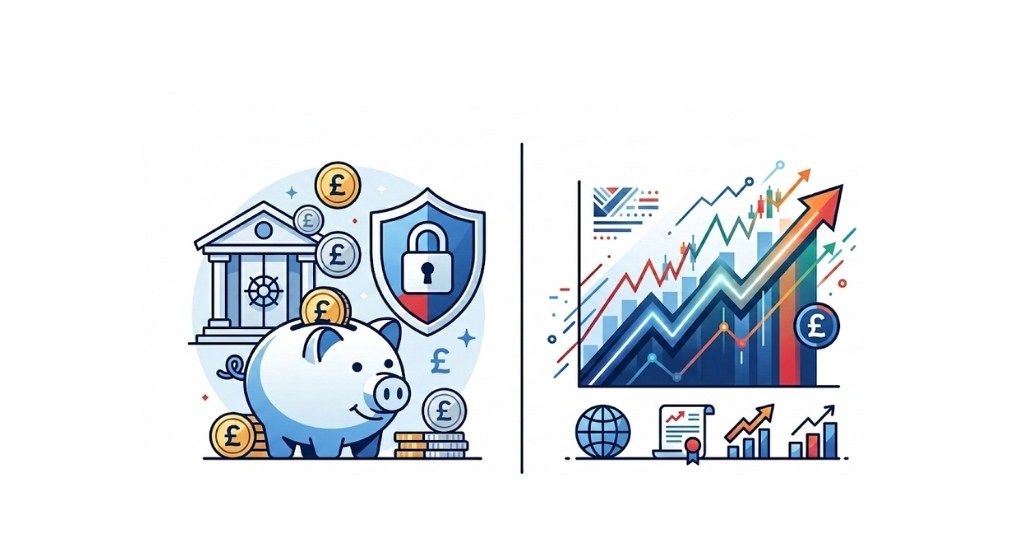
Cash ISAs are designed for savers who want stability, easy access and no market risk to their capital. Top easy-access Cash ISA rates in early March 2026 are around 4.4% AER, though many headline rates include a temporary bonus and variable rates can change. Stocks and Shares ISAs are designed for long-term investing and have historically outperformed cash over longer periods, but returns are not guaranteed and values can fall. For many people, the best answer is not one or the other, but a mix of both.
If you are deciding where to use your ISA allowance this tax year, you are far from alone. Both Cash ISAs and Stocks and Shares ISAs shelter your returns from UK tax, and the adult ISA allowance remains £20,000 for the 2025/26 tax year. Since April 2024, most adults have also been able to pay into multiple ISAs of the same type in the same tax year, subject to some exceptions.
The key difference is simple. A Cash ISA pays interest on savings. A Stocks and Shares ISA holds investments such as funds, shares, bonds and ETFs. One prioritises security and certainty. The other prioritises long-term growth potential.
Cash ISA vs Stocks and Shares ISA at a glance
| Feature | Cash ISA | Stocks and Shares ISA |
|---|---|---|
| How it works | Pays interest on cash savings | Holds investments such as funds, shares, bonds and ETFs |
| Typical return profile | Top easy-access rates around 4.4% AER in early March 2026, variable and subject to change | Returns depend on the investments chosen and can rise or fall |
| Risk to capital | No market risk to capital, subject to provider eligibility and FSCS deposit limits | Investments can fall in value and you could get back less than you invested |
| Tax benefits | Interest is tax-free inside the ISA | No UK tax on capital gains, dividends or interest inside the ISA |
| Best time horizon | Short term, typically 1 to 3 years | Long term, typically at least 5 years |
| Inflation protection | Often limited over long periods | Historically stronger over long periods, though not guaranteed |
| Allowance in 2025/26 | Shares the £20,000 annual ISA allowance | Shares the £20,000 annual ISA allowance |
What is a Cash ISA?
A Cash ISA is a tax-free savings account. It works in much the same way as an ordinary savings account, except the interest you earn is sheltered from UK tax. You can open Cash ISAs with banks, building societies and some fintech providers.
Cash ISAs usually come in three main forms: easy access, fixed rate and notice accounts. Easy-access accounts let you withdraw more freely, fixed-rate accounts usually lock your money away for a set period in return for a fixed rate, and notice accounts require advance warning before withdrawals.
In early March 2026, the best easy-access Cash ISA rates are around 4.40% AER, while leading one-year fixed Cash ISAs are around 4.25% AER. Those figures can move quickly, and many easy-access headline rates include introductory bonuses, so it is worth checking the underlying rate before opening an account.
Eligible deposits are protected by the Financial Services Compensation Scheme up to £120,000 per person, per authorised institution, for firms that fail on or after 1 December 2025. That is an increase from the previous £85,000 limit.
What is a Stocks and Shares ISA?
A Stocks and Shares ISA is a tax wrapper for investments rather than cash. Inside one, you can usually hold funds, shares, bonds, ETFs and investment trusts. Any capital gains, dividends or interest generated within the account are sheltered from UK tax.
That tax shelter can be especially valuable now that the Capital Gains Tax annual exempt amount is £3,000 and the dividend allowance is £500. Outside an ISA, investors may face tax once they exceed those allowances. Inside an ISA, those returns are generally sheltered.
The trade-off is risk. Unlike a Cash ISA, a Stocks and Shares ISA exposes you to market movements. Your investments can go down as well as up, and you may get back less than you originally invested. FSCS investment protection can apply if an authorised firm fails, but it does not protect you against normal market losses.
Which has performed better over time?
Over short periods, Cash ISAs can look attractive, especially when savings rates are relatively high. But over longer periods, investing has historically produced stronger returns than cash.
A recent comparison covering February 2025 to February 2026 put average Stocks and Shares ISA growth at 11.22%, versus 3.48% for average Cash ISA returns over the same period. That does not mean investment returns will always beat cash in any given year, but it does show how different the outcomes can be.
Long-term data is even more striking. AJ Bell analysis using ISA-era data from 1999 to September 2025 found that £1,000 invested in the average Cash ISA in April 1999 grew to about £2,079, while the same amount invested in the average UK All Companies fund grew to around £3,787. A similar investment in the average North America fund grew to roughly £6,285.
For regular savers, the gap was wider still. Someone investing £1,000 a year from 1999 to 2025 built up around £36,290 in the average Cash ISA, compared with £67,866 in UK equities, £92,349 in global equities and £127,887 in North American equities, using AJ Bell’s methodology.
That does not mean shares always win in the short run. It means that historically, for people with a long enough time horizon, investing has offered stronger growth potential than cash.
What about inflation?
Inflation matters because it affects the real spending power of your money. UK CPI inflation was 3.0% in the 12 months to January 2026, down from 3.4% in December 2025.
If your Cash ISA pays 4% and inflation is 3%, your real return is only about 1% before considering any future rate changes. If inflation rises above your savings rate, the spending power of your money falls in real terms even if your account balance increases.
Equities have historically offered better inflation protection over long periods. Barclays Equity Gilt Study data, as cited by investment firms discussing the study, shows UK equities delivering roughly 3.1% a year above inflation over 20 years, while cash lost around 1.8% a year in real terms over that period.
How does tax compare?
Both ISA types are attractive because returns inside the wrapper are generally tax-free. You do not pay UK tax on interest, dividends or capital gains generated within an ISA, and ISA income and gains generally do not need to be reported on a tax return.
For Cash ISAs, the tax benefit is most valuable once your savings interest starts to exceed your Personal Savings Allowance. Basic-rate taxpayers can usually earn £1,000 of savings interest tax-free each year, higher-rate taxpayers £500, and additional-rate taxpayers get no Personal Savings Allowance.
At a 4% interest rate, a higher-rate taxpayer with £12,500 in a taxable savings account would use up their £500 Personal Savings Allowance. Beyond that, a Cash ISA can become much more useful.
For investors, the ISA tax shelter is arguably even more powerful because it protects you from dividend tax and capital gains tax. In 2025/26, dividend tax rates are 8.75%, 33.75% and 39.35%, depending on your tax band, and gains above the £3,000 CGT allowance may be taxable outside an ISA.
Can you have both?
Yes. You can hold both a Cash ISA and a Stocks and Shares ISA in the same tax year, provided your total subscriptions across all adult ISAs stay within the £20,000 annual allowance. Since the rule changes introduced from April 2024, most adults can also subscribe to multiple ISAs of the same type in the same year, though special restrictions still apply to some ISA categories.
For many people, using both makes sense. A common approach is to keep an emergency fund or short-term savings in cash, while investing money that is not needed for at least five years.
What is changing from April 2027?
One of the biggest announced ISA changes is due from 6 April 2027. HMRC has published that the annual Cash ISA subscription limit will be capped at £12,000 for under-65s, while the overall adult ISA allowance remains £20,000. Investors aged 65 and over will still be able to subscribe up to the full £20,000 into a Cash ISA.
That means younger savers who want to use their full ISA allowance will need to put any amount above £12,000 into a Stocks and Shares ISA or another eligible non-cash ISA type. Existing Cash ISA balances are not being stripped of their tax-free status.
The reforms are broader than just the cap. HMRC has also outlined related anti-circumvention measures, including restrictions connected to transfers into Cash ISAs and a new framework for judging what counts as “cash-like”.
Which ISA is right for you?
A Cash ISA may be the better choice if you need the money within the next few years, are building an emergency fund, or cannot afford any fall in the value of your capital. It is generally the more suitable home for short-term goals and money you may need at short notice.
A Stocks and Shares ISA may be the better choice if you are investing for at least five years, can tolerate market ups and downs, and want a better chance of beating inflation over time. It is typically more suitable for long-term goals such as retirement or long-range wealth building.
For many savers and investors, the best solution is a blend of both: cash for stability and access, investments for long-term growth.
Final verdict
Cash ISAs and Stocks and Shares ISAs are both valuable, but they serve different jobs. A Cash ISA is about certainty, security and short-term access. A Stocks and Shares ISA is about long-term growth and accepting investment risk in pursuit of better returns. Neither is universally “better”. The right option depends on when you need the money, how much volatility you can tolerate and what you want the money to do for you.