If you want the cheapest SIPP in the UK, InvestEngine and Freetrade both charge £0 in platform fees. But a £0 platform fee is not the same as a £0 pension, and for most people the genuinely cheapest SIPP depends on two things: how big your pot is, and whether you hold ETFs or funds.
This guide compares what every major UK SIPP platform actually costs each year, at pot sizes from £10,000 to £500,000, using each provider's published charges as at August 2026. We have separated ETF and share portfolios from fund portfolios, because the cheapest platform is rarely the same for both.
Two things changed in 2026 that most comparison tables have not caught up with. Hargreaves Lansdown cut its SIPP fund charge from 0.45% to 0.35% on 1 March 2026, and interactive investor now charges a pension admin fee on top of its headline monthly plan price. Both are covered below.
Cheapest SIPP UK at a glance
| Platform | Platform fee | Dealing | Cheapest for |
|---|---|---|---|
| InvestEngine | £0 (DIY) | £0 | ETF-only investors, any pot size |
| Freetrade | £0 (Basic plan) | £0 | Small pots, UK-listed assets |
| AJ Bell | 0.25%, capped £10/mo on shares | £5 shares, £1.50 funds | Share and ETF portfolios £50k+ |
| Fidelity | 0.35%, capped £7.50/mo on shares | £1.50 funds | ETF portfolios, lowest cap on the market |
| interactive investor | £8.49/mo (Core) or £20.99/mo (Plus) | From £3.99 | Large fund portfolios £250k+ |
| Vanguard | 0.15%, capped £375/yr | £0 | Simple index portfolios £32k–£100k |
| Hargreaves Lansdown | 0.35%, capped £12.50/mo on shares | £6.95 shares, £1.95 funds | Research and service, not price |
Figures are platform or service charges only. They exclude the ongoing charges figure (OCF) of the funds and ETFs you buy, dealing commission, and foreign exchange costs.
Annual SIPP fees compared: ETF and share portfolios
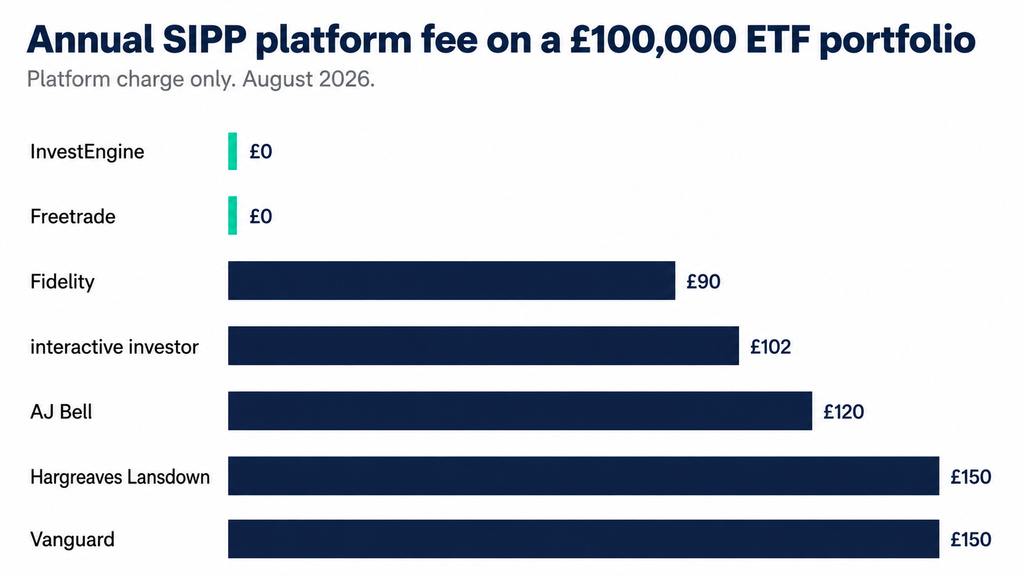
This is what each platform charges per year to hold a SIPP made up of ETFs, shares or investment trusts. Most platforms cap this charge, which is why the columns flatten out.
| Platform | £10,000 | £50,000 | £100,000 | £250,000 | £500,000 |
|---|---|---|---|---|---|
| InvestEngine | £0 | £0 | £0 | £0 | £0 |
| Freetrade (Basic) | £0 | £0 | £0 | £0 | £0 |
| AJ Bell | £25 | £120 | £120 | £120 | £120 |
| Fidelity | £35 | £90 | £90 | £90 | £90 |
| Hargreaves Lansdown | £35 | £150 | £150 | £150 | £150 |
| Vanguard | £48 | £75 | £150 | £375 | £375 |
| interactive investor | £102 | £102 | £102 | £252 | £252 |
The headline here is how cheap the capped platforms become at scale. Fidelity caps its exchange-traded charge at £7.50 a month, which works out at £90 a year whether you hold £30,000 or £500,000. AJ Bell caps at £10 a month, Hargreaves Lansdown at £12.50 a month.
Vanguard is the outlier. It has one of the lowest percentage fees on the market at 0.15%, but because its cap is £375 a year rather than around £100, it becomes the most expensive mainstream option for a large ETF portfolio.
Annual SIPP fees compared: fund portfolios
Funds are where the gap gets wide. Most platforms do not cap the charge on unit trusts and OEICs, so a percentage fee keeps growing with your pot.
| Platform | £10,000 | £50,000 | £100,000 | £250,000 | £500,000 |
|---|---|---|---|---|---|
| Freetrade (Basic) | £0 | £0 | £0 | £0 | £0 |
| AJ Bell | £25 | £125 | £250 | £625 | £875 |
| Vanguard | £48 | £75 | £150 | £375 | £375 |
| interactive investor | £102 | £102 | £102 | £252 | £252 |
| Fidelity | £90 | £175 | £350 | £500 | £1,000 |
| Hargreaves Lansdown | £35 | £175 | £350 | £875 | £1,500 |
| InvestEngine | Not available — InvestEngine offers ETFs only | ||||
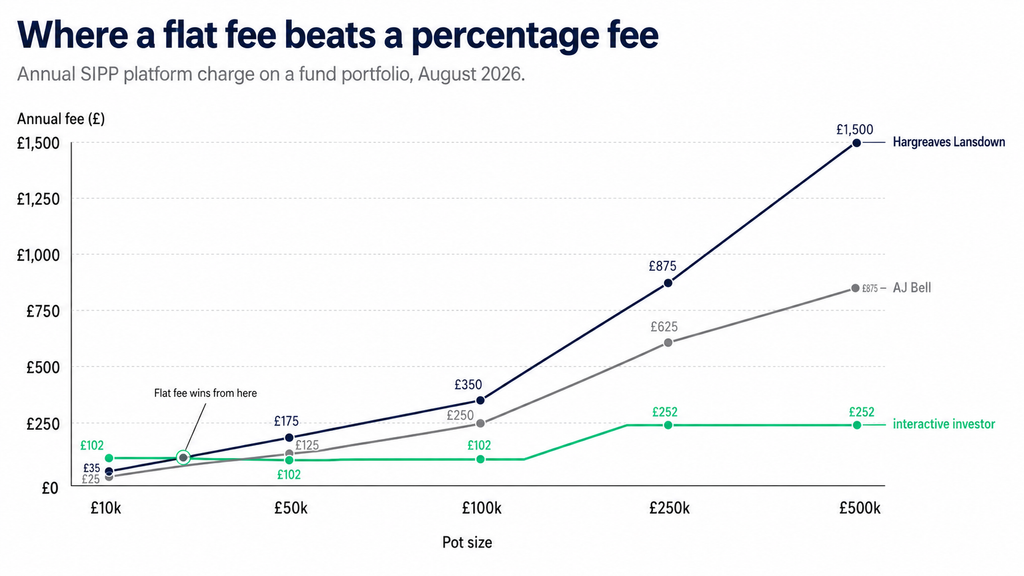
At £500,000 in funds, Hargreaves Lansdown charges £1,500 a year and interactive investor charges £252. That is a £1,248 annual difference for holding the same investments, and it is the single strongest argument for flat-fee pricing on a large pension.
The crossover point matters. Below roughly £50,000, percentage fees are cheaper than ii's flat fee. Above roughly £100,000 in funds, flat pricing wins comfortably.
Why a £0 platform fee is not a £0 pension
InvestEngine and Freetrade top every fee table, and for a lot of investors they genuinely are the cheapest option. But there are real costs that never appear in a platform fee column, and you should price them in before switching.
Fund and ETF charges still apply. Every ETF has an ongoing charges figure deducted inside the fund. A global tracker typically costs 0.10% to 0.25% a year. On a £100,000 pot that is £100 to £250 annually, which dwarfs most platform fees.
Foreign exchange costs. Freetrade charges 0.99% FX on non-GBP trades on its free Basic plan, falling to 0.59% on Standard and 0.39% on Plus. If you buy US-listed stocks regularly, that FX charge can easily exceed what a capped platform would have charged you. Buying UK-listed ETFs avoids it.
Restricted investment choice. InvestEngine offers ETFs only: no individual shares, no investment trusts, no OEICs. Vanguard only offers Vanguard's own funds and ETFs. If your strategy needs something outside those ranges, the fee saving is irrelevant.
Interest retained on your cash. Platforms that charge nothing usually make money by keeping some or all of the interest on your uninvested cash. If you hold a meaningful cash buffer in your SIPP, check what rate you actually receive.
Missing retirement features. Freetrade does not currently offer drawdown, and InvestEngine's drawdown options are limited. That is fine while you are building a pot, but it means a second transfer later, when your pension is much larger and the stakes are higher.
The cheapest SIPP for your pot size
Under £30,000. InvestEngine or Freetrade at £0, provided ETF-only or UK-listed investing suits you. If you want funds and research instead, Hargreaves Lansdown at 0.35% costs just £35 a year on a £10,000 pot, which is less than Vanguard's £48 flat charge at that level.
£30,000 to £100,000. This is where capped platforms start to earn their keep. Fidelity at £90 a year and AJ Bell at £120 a year for ETFs and shares are hard to beat if you want a full-featured platform. Vanguard at 0.15% stays competitive up to about £100,000 for a simple index portfolio.
£100,000 to £250,000. Capped ETF pricing dominates. Fidelity's £90 cap is the cheapest on the market for a share and ETF portfolio at this size. For funds, interactive investor's Core plan at £101.88 a year is excellent value right up to the £100,000 plan threshold.
£250,000 and above. Flat fees win decisively for funds. interactive investor's Plus plan costs £251.88 a year regardless of pot size. For ETFs and shares, Fidelity at £90 or AJ Bell at £120 stay cheaper still. Percentage-fee platforms become expensive fast at this level.
For a wider comparison that weighs investment range, drawdown and service rather than price alone, see our guide to the best SIPP providers in the UK.
Two 2026 fee changes worth knowing about
Hargreaves Lansdown cut its SIPP fund charge on 1 March 2026. The annual charge on funds fell from 0.45% to 0.35% on the first £250,000, then 0.25% from £250,000 to £1 million, 0.10% from £1 million to £2 million and nothing above that. Share dealing also came down to £6.95 for up to 19 trades a month. HL is still not the cheapest platform, but the gap has narrowed, and older comparison articles still quoting 0.45% and £11.95 are out of date.
interactive investor charges a pension admin fee on top of the plan price. The advertised Core plan is £5.99 a month, but holding a SIPP adds £2.50 a month including VAT, taking the real cost to £8.49 a month, or £101.88 a year. On the Plus plan it is £14.99 plus £6, so £20.99 a month, or £251.88 a year. Those are the figures used throughout this guide, because they are what you actually pay.
What a small fee difference really costs
Pension fees compound against you for decades, which is why a difference that looks trivial each year is not trivial at all by retirement.
Take a £20,000 SIPP invested in ETFs, growing at 7% a year gross for 30 years with no further contributions. Paying nothing in platform fees leaves you with roughly £152,200. Paying Hargreaves Lansdown's capped £150 a year leaves roughly £140,900.
That is a difference of about £11,300 from a charge of under £13 a month. The figures are illustrative, exclude fund charges, dealing costs and inflation, and assume a constant growth rate that no real portfolio delivers. But the direction of travel is the point: on a pension you might hold for 30 or 40 years, fees are one of the very few variables you can actually control.
What to check before switching on price alone
Cheapest is not automatically best, and a pension transfer is not a decision to rush.
Check what you would lose. Older workplace and personal pensions sometimes carry guaranteed annuity rates, a protected pension age or enhanced tax-free cash. These benefits can be worth far more than any fee saving and are usually lost on transfer. If your pension has any safeguarded benefits, take regulated advice first.
Check exit fees. Most modern platforms have scrapped them, and AJ Bell will cover exit fees up to £500 when you transfer in, but older providers may still charge.
Check drawdown before you need it. interactive investor, AJ Bell, Fidelity and Hargreaves Lansdown all offer full flexible drawdown at no extra charge. Freetrade and InvestEngine currently do not, so plan for a second transfer if you use them to accumulate.
Check whether an ISA is the better home. A SIPP gives you tax relief going in but locks the money away until 57 from April 2028. Our guide to SIPPs versus ISAs covers the trade-off, and SIPP tax relief explains what you get back and how to claim the higher-rate portion. If you are new to pensions entirely, start with what a SIPP is.
Cheapest SIPP FAQs
What is the cheapest SIPP in the UK?
InvestEngine and Freetrade both charge £0 in platform fees on their standard plans, making them the cheapest SIPPs in the UK on headline cost. InvestEngine is ETF-only, and Freetrade charges 0.99% FX on non-GBP trades on its free Basic plan. For a full-featured platform, Fidelity's £90 a year cap on shares and ETFs is the lowest capped charge among the large providers.
Is a flat-fee or percentage-fee SIPP cheaper?
Percentage fees are cheaper on small pots and flat fees are cheaper on large ones. For fund portfolios the crossover with interactive investor's Core plan sits at roughly £30,000 to £50,000. Above about £100,000 in funds, flat pricing is clearly cheaper.
How much are SIPP fees on average?
Most UK SIPP platforms charge between 0.15% and 0.45% a year, or a flat £8 to £21 a month. On top of that you pay the ongoing charges of your funds or ETFs, typically 0.03% to 0.25% a year for index products, plus any dealing commission.
Does Trading 212 offer a SIPP?
No. Neither Trading 212 nor eToro currently offers a SIPP. If you want commission-free pension investing, InvestEngine and Freetrade are the closest equivalents.
Can I transfer my SIPP to a cheaper provider?
Yes, and most transfers take two to six weeks. Transfer in specie where possible so you stay invested during the move. Check first for exit fees and for safeguarded benefits such as guaranteed annuity rates, which you would give up.
Do SIPP fees come out of my pension or my bank account?
Almost always out of the pension itself, usually from an uninvested cash balance within the SIPP. If there is not enough cash, platforms will normally sell units to cover the charge, so it is worth keeping a small cash buffer.
The value of pensions and investments can go down as well as up and you may get back less than you invested. Tax treatment depends on individual circumstances and may change. You cannot normally access pension savings until age 55, rising to 57 from April 2028. Fee figures are correct as at 26 August 2026 and may change, so always check the provider's own charges page before opening or transferring an account. This guide is for informational purposes only and does not constitute financial advice.
Conclusion
On headline platform charges, InvestEngine and Freetrade are the cheapest SIPPs in the UK, and for an ETF investor building a pot they are genuinely difficult to beat. Their limits are investment choice and retirement features rather than cost.
If you want a full-featured platform, the capped providers are where the value sits. Fidelity's £90 a year cap on shares and ETFs is the lowest of the large platforms, with AJ Bell close behind at £120. For fund portfolios above £100,000, interactive investor's flat pricing at £251.88 a year beats every percentage-based competitor by a wide margin.
Whichever you choose, compare the total cost rather than the headline fee. Platform charge, fund OCF, dealing commission and FX together are what actually come out of your pension, and over a 30-year horizon the difference between the cheapest and most expensive option runs into five figures.