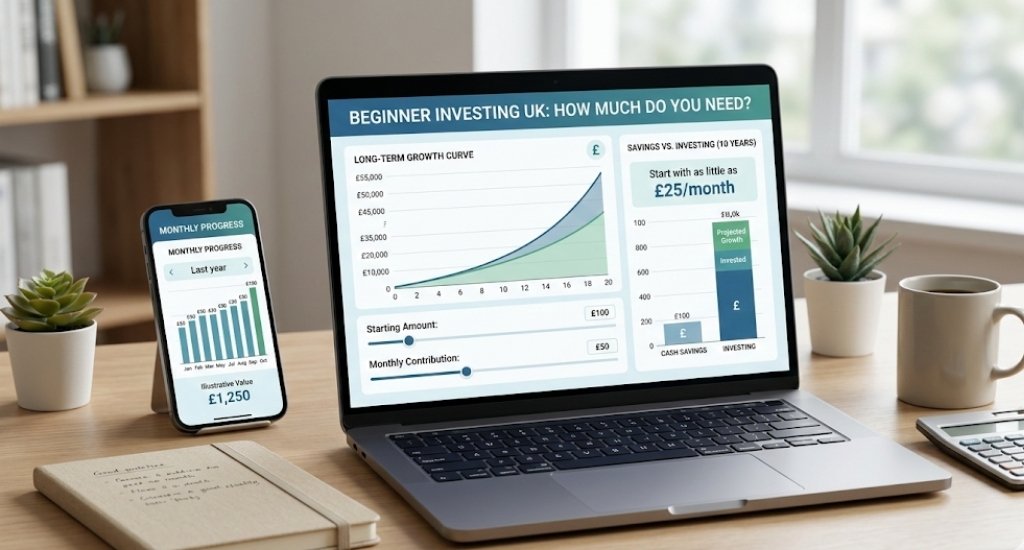
You can start investing in the UK with as little as 1 pound. Commission-free platforms like Trading 212 and InvestEngine offer fractional shares, meaning you do not need hundreds or thousands of pounds to begin. The most important thing is to start early and invest regularly, even with small amounts, because compound growth rewards time in the market far more than the size of your initial investment.
What Is the Minimum Investment for UK Platforms in 2026?
Different platforms have different minimums. Here is what you need to get started with the most popular UK providers:
| Platform | Minimum Lump Sum | Minimum Monthly | Account Fee |
| Trading 212 | 1 pound | No minimum | Free |
| InvestEngine | 100 pounds (20 pounds/month) | 20 pounds | Free (DIY) |
| Freetrade | 2 pounds | No minimum | Free (Basic) |
| Vanguard | 100 pounds (or 25 pounds/month) | 25 pounds | 0.15% |
| AJ Bell | 25 pounds (lump or monthly) | 25 pounds | 0.25% |
| Hargreaves Lansdown | 100 pounds (or 25 pounds/month) | 25 pounds | 0.45% |
| Interactive Investor | No minimum | No minimum | From 5.99 pounds/month |
| Nutmeg (JP Morgan) | 500 pounds | 100 pounds DD if under 5,000 pounds | 0.45% to 0.75% |
| Moneyfarm | 500 pounds | N/A | 0.70% |
(Source: Provider websites, February 2026.)
How Much Should a Beginner Actually Invest?
The right amount depends on your personal circumstances. Before investing anything, most financial guidance recommends:
1. Clear high-interest debt first. If you have credit card debt at 20%+ interest, paying it off will give you a guaranteed return that almost no investment can match.
2. Build an emergency fund. Aim for three to six months of essential expenses in an easily accessible savings account. This protects you from having to sell investments at a bad time.
(Source: MoneyHelper emergency fund guidance, 2025.)
3. Invest what you can afford to leave for five years or more. Stock market investing is a long-term commitment. Only invest money you will not need in the short term.
After covering these basics, invest as much as you can comfortably afford. Even 50 pounds per month can grow to a meaningful sum over time.
How Much Can Small Monthly Investments Grow Into?
Compound growth turns small, regular contributions into surprisingly large sums over time. The table below shows what different monthly amounts could be worth inside a tax-free Stocks and Shares ISA at 7% average annual growth:
| Monthly Amount | After 5 Years | After 10 Years | After 20 Years | After 30 Years |
| 25 pounds | 1,800 pounds | 4,300 pounds | 13,000 pounds | 30,700 pounds |
| 50 pounds | 3,600 pounds | 8,700 pounds | 26,000 pounds | 61,300 pounds |
| 100 pounds | 7,200 pounds | 17,300 pounds | 52,100 pounds | 122,700 pounds |
| 200 pounds | 14,300 pounds | 34,600 pounds | 104,800 pounds | 245,400 pounds |
| 500 pounds | 35,800 pounds | 86,500 pounds | 260,500 pounds | 613,500 pounds |
Assumes 7% annual growth compounded monthly, no fees deducted. Actual returns will vary. Use our ISA calculator for personalised projections.
Starting with just 50 pounds per month from age 25 could give you over 61,000 pounds by age 55, all tax-free in an ISA. Start at 100 pounds per month and that doubles to over 122,000 pounds.
How Much Could a Lump Sum Grow Over Time?
If you have a lump sum to invest (from savings, an inheritance or a bonus), here is how different amounts could grow at 7% annual return:
| Lump Sum | After 10 Years | After 20 Years | After 30 Years |
| 1,000 pounds | 1,970 pounds | 3,870 pounds | 7,610 pounds |
| 5,000 pounds | 9,840 pounds | 19,350 pounds | 38,060 pounds |
| 10,000 pounds | 19,670 pounds | 38,700 pounds | 76,120 pounds |
| 20,000 pounds | 39,340 pounds | 77,390 pounds | 152,240 pounds |
A one-off 10,000 pound investment could grow to over 38,000 pounds in 20 years. Combining a lump sum with regular monthly contributions accelerates growth even further.
Why Does Starting Early Matter More Than Starting Big?
The biggest advantage in investing is time, not the amount you start with. Consider two investors:
Investor A: Starts at age 25, invests 100 pounds per month for 30 years (total contributed: 36,000 pounds). At 7% annual growth, their portfolio could be worth approximately 122,700 pounds by age 55.
Investor B: Starts at age 35, invests 200 pounds per month for 20 years (total contributed: 48,000 pounds). At 7% annual growth, their portfolio could be worth approximately 104,800 pounds by age 55.
Investor A contributes 12,000 pounds less but ends up with nearly 18,000 pounds more. That is the power of compound growth over a longer time period. Starting early, even with small amounts, is one of the most effective things you can do for your financial future.
What Are the Best Ways to Start Investing With Small Amounts?
Use a free platform: Avoid platforms that charge dealing fees or high percentages on small portfolios. Trading 212 and InvestEngine charge nothing for DIY investing.
Buy fractional shares: With fractional shares, you can buy a slice of any share or ETF from as little as 1 pound. This means you do not need to save up for a full share of expensive stocks.
Start with a global index fund: A single global tracker (like Vanguard FTSE All-World ETF or iShares Core MSCI World) gives you instant diversification across thousands of companies. See our guide on how to invest in index funds.
Automate monthly investing: Set up a standing order or direct debit so investing happens automatically each month. This removes the temptation to time the market and builds consistency.
Use a Stocks and Shares ISA: Even with small amounts, investing inside an ISA ensures your returns are completely tax-free as your portfolio grows.
What Mistakes Should Beginners Avoid?
Waiting until you have 'enough': There is no perfect amount to start with. Waiting costs you compound growth. Starting with 25 or 50 pounds per month is far better than waiting until you can afford 500.
Choosing expensive platforms: Percentage-based fees are fine for small amounts, but flat-fee platforms (like Interactive Investor at 5.99 pounds per month) become expensive relative to small portfolios. Match your platform to your portfolio size.
Checking your investments daily: Short-term market movements are normal. Frequent checking leads to emotional decisions. Set up your investments and review them quarterly or annually.
Not using tax wrappers: Always invest inside an ISA or SIPP to protect your returns from tax. There is no minimum to benefit from this.
Frequently Asked Questions
Can I start investing with 10 pounds?
Yes. Platforms like Trading 212 let you invest from as little as 1 pound using fractional shares. You can buy a portion of any share or ETF listed on the platform.
Is it worth investing 50 pounds a month?
Absolutely. At 7% annual growth, 50 pounds per month could grow to approximately 8,700 pounds after 10 years and over 26,000 pounds after 20 years. Every pound invested early benefits from compound growth.
How much should a beginner invest?
Start with whatever you can comfortably afford after covering essential expenses and maintaining an emergency fund. Even 25 to 50 pounds per month is a solid starting point. You can always increase contributions as your income grows.
Is 1,000 pounds enough to start investing?
Yes. A 1,000 pound lump sum is a great starting point and gives you enough to build a diversified portfolio using index funds or ETFs. At 7% annual growth, it could be worth nearly 2,000 pounds in 10 years, and adding regular monthly contributions accelerates growth significantly.
Should I pay off debt before investing?
Generally, yes for high-interest debt (credit cards, personal loans above 5% to 6%). The guaranteed savings from clearing high-interest debt usually outweigh potential investment returns. Low-interest debt (student loans, low-rate mortgages) can often be managed alongside investing.
What is the best account to start investing?
A Stocks and Shares ISA is the best starting point for most UK investors. All returns are tax-free, you can invest up to 20,000 pounds per year, and you can withdraw at any time.
Do I need to invest every month?
No, but regular investing is recommended. Monthly contributions help you benefit from pound-cost averaging and build a consistent saving habit. Most platforms let you pause or adjust contributions at any time.
How do I choose between platforms?
For small amounts (under 10,000 pounds), choose platforms with no or low percentage-based fees like Trading 212 (free) or InvestEngine (free). For larger amounts (over 20,000 to 30,000 pounds), flat-fee platforms like Interactive Investor become better value. See our best trading platforms UK comparison.
Related Reading
How to Invest in Index Funds UK