To buy ETFs in the UK, open an account with an FCA-regulated platform like Trading 212, InvestEngine or Vanguard. Choose a stocks and shares ISA for tax-free investing, search for your ETF by name or ticker, and buy. Most ETFs charge just 0.03% to 0.25% per year, making them one of the cheapest ways to invest.
Exchange-traded funds (ETFs) are one of the simplest and most cost-effective ways to invest. A single ETF can give you instant exposure to hundreds or even thousands of companies, providing built-in diversification without the complexity of picking individual stocks.
ETFs trade on stock exchanges just like shares, which means you can buy and sell them throughout the trading day at a visible price. They combine the diversification of a fund with the trading flexibility of a stock. This guide explains exactly how to buy ETFs in the UK, what they cost, and how to hold them tax-efficiently.
What Is an ETF?
An ETF (exchange-traded fund) is a fund that holds a basket of investments, usually tracking an index, sector, commodity or asset class. When you buy one share of an ETF, you own a small portion of everything in that basket.
For example, a FTSE 100 ETF holds all 100 companies in the FTSE 100 index. If you buy one unit, you effectively own a tiny slice of every company in the index. As the index rises or falls, so does your ETF.
ETFs vs Index Funds
ETFs and index funds both track market indices, but they differ in how you buy them. ETFs trade on stock exchanges throughout the day at a live price (like shares). Index funds (OEICs/unit trusts) are priced once per day and bought directly from the fund provider. For most beginners, the difference is minimal. ETFs tend to have slightly lower ongoing charges and offer more trading flexibility.
Physical vs Synthetic ETFs
Physical ETFs buy and hold the actual underlying assets (shares, bonds). Synthetic ETFs use derivatives (swaps) to replicate returns without owning the assets directly. Physical ETFs are simpler and more transparent. Synthetic ETFs can access harder-to-reach markets but carry slight counterparty risk. Most beginners should stick with physical ETFs.
Key Takeaway: ETFs give you instant diversification at very low cost. A single global ETF can give you exposure to thousands of companies across dozens of countries, with annual charges as low as 0.07%.
How to Buy ETFs in the UK: Step by Step
Step 1: Choose an FCA-Regulated Platform
You need a broker regulated by the Financial Conduct Authority (FCA) that offers ETF trading. Here are some popular choices:
Best UK ETF Platforms
| Platform | ETF Commission | Platform Fee | ISA? | Best For |
|---|---|---|---|---|
| InvestEngine | Free | 0% (DIY) | Yes | Fee-free ETF investing |
| Trading 212 | Free | 0% | Yes | Commission-free + fractional |
| Vanguard | Free | 0.15% (capped £375) | Yes | Low-cost Vanguard ETFs |
| Hargreaves Lansdown | £11.95/trade | 0.45% (capped) | Yes | Widest ETF range |
| Interactive Investor | £3.99/trade | From £4.99/mo | Yes | Flat fee for larger pots |
| AJ Bell | £1.50/trade | 0.25% | Yes | Low dealing fees |
Step 2: Open Your Account
Opening an account takes 5 to 10 minutes. You will need proof of identity, your National Insurance number and bank details. Choose a stocks and shares ISA for tax-free investing (up to £20,000 per year) or a General Investment Account (GIA) if you have used your ISA allowance (Source: HMRC, 2025/26).
Step 3: Decide What Type of ETF to Buy
ETFs come in many varieties. The most popular categories for UK beginners are:
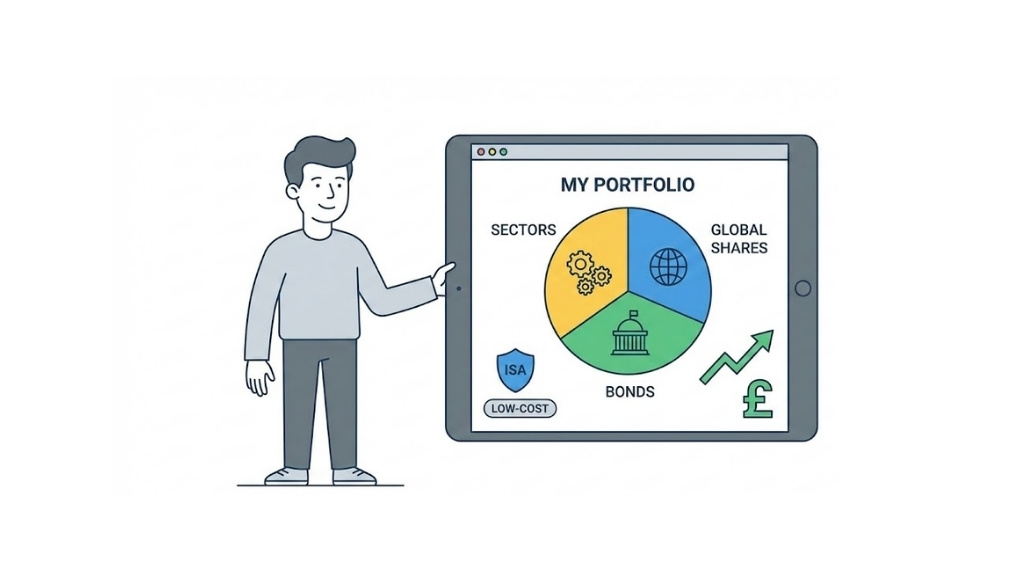
- Global equity ETFs: Track the entire world stock market (e.g. FTSE All-World, MSCI World). Best for core, long-term holdings.
- UK equity ETFs: Track FTSE 100 or FTSE All-Share. Good for UK-focused portfolios.
- US equity ETFs: Track the S&P 500 or NASDAQ. Popular for US market exposure.
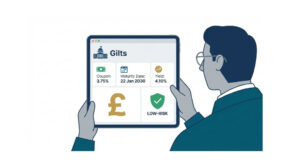
- Bond ETFs: Hold government bonds (gilts) or corporate bonds. Lower risk, lower returns.
- Sector/theme ETFs: Focus on specific areas like technology, healthcare, clean energy or AI.
See our best ETFs UK guide for specific recommendations.
Step 4: Research Your ETF
Before buying, check these key details:
- OCF (Ongoing Charges Figure): The annual cost of the ETF. Lower is better. Most broad index ETFs charge 0.03% to 0.25%.
- Fund size (AUM): Larger funds tend to have better liquidity and tighter bid-ask spreads. Aim for ETFs with at least £100 million in assets.
- Tracking index: Make sure the ETF tracks the index you want. Check the factsheet.
- Accumulating vs distributing: Accumulating ETFs reinvest dividends automatically. Distributing ETFs pay dividends to your account. Most long-term investors prefer accumulating.
- Domicile: Most UK-available ETFs are domiciled in Ireland (UCITS ETFs), which is tax-efficient for UK investors.
Step 5: Place Your Order
Search for your ETF by name or ticker (e.g. VWRL, CSP1, ISF). Select a market order (buys at the current price) or limit order (sets the maximum price you will pay). ETFs trade during exchange hours, typically 8:00 AM to 4:30 PM for UK-listed ETFs.
Step 6: Set Up Regular Investing
Many platforms allow you to set up automatic monthly investments into your chosen ETFs. This is an effective way to practise pound cost averaging, reducing the impact of market volatility over time. Some platforms waive dealing fees for regular investments.
Key Takeaway: The cheapest way to buy ETFs in the UK is through a commission-free platform like InvestEngine or Trading 212 inside a stocks and shares ISA. This eliminates both trading fees and UK tax.
What Does It Cost to Buy ETFs in the UK?
ETF costs have three main components:
OCF (Ongoing Charges Figure): Charged by the ETF provider. Typically 0.03% to 0.25% for broad index ETFs. Deducted from the fund's value, not charged separately.
Platform/custody fee: Charged by your broker for holding the ETF. Ranges from 0% (InvestEngine, Trading 212) to 0.45% (Hargreaves Lansdown). Some platforms charge a flat monthly fee instead.
Dealing/trading fee: Charged per trade. Free on some platforms, £1.50 to £11.95 on others. If you invest monthly, dealing fees add up, so commission-free platforms offer significant savings.
For a £10,000 portfolio in a FTSE 100 ETF with a 0.07% OCF on a 0% platform fee broker, your total annual cost would be approximately £7. On a 0.45% platform, the same portfolio costs around £52 per year. Over 20 years, this difference compounds significantly (Source: FCA, 2025).
Accumulating vs Distributing ETFs: Which Should You Choose?
Accumulating (Acc): Dividends are automatically reinvested into the ETF, increasing the value of your units. Best for long-term growth investors who want the power of compounding without manual reinvestment. Examples: VUAG (Vanguard S&P 500 Acc), VWRP (Vanguard FTSE All-World Acc).
Distributing (Dist): Dividends are paid out to your account as cash (typically quarterly). Best for income investors or those who want to choose where to reinvest. Examples: VUSA (Vanguard S&P 500 Dist), VWRL (Vanguard FTSE All-World Dist).
Inside an ISA, there is no tax difference between accumulating and distributing ETFs. Outside an ISA, accumulating ETFs are slightly simpler for tax reporting.
Tax Rules for Buying ETFs in the UK
Inside a stocks and shares ISA: All gains and income from ETFs are completely tax-free. No capital gains tax, no dividend tax, no income tax. This is the most tax-efficient way to hold ETFs (Source: HMRC, 2025/26).
Inside a SIPP: Growth is tax-free. Contributions receive tax relief. Withdrawals are taxed as income in retirement. See our SIPP guide.
Outside a tax wrapper (GIA): Gains above the £3,000 annual CGT allowance are taxed at 18% (basic) or 24% (higher) for 2025/26. ETF dividends count towards your £500 dividend allowance (Source: HMRC, 2025/26).
Stamp duty: There is no stamp duty on ETFs. Stamp duty reserve tax (0.5%) only applies to UK-listed individual shares, not ETFs (Source: HMRC).
Frequently Asked Questions
On platforms offering fractional ETF investing (like Trading 212 and InvestEngine), you can start from as little as £1. On whole-unit platforms, you need enough to buy at least one ETF unit, which varies by fund but is often between £10 and £100.
ETF providers are regulated, and your holdings are held separately from the provider's assets. However, the value of ETF investments can go down as well as up. ETFs tracking equities carry market risk. Your cash (up to £85,000) is protected by the FSCS if your broker fails.
Yes. Most UK brokers allow you to hold ETFs inside a stocks and shares ISA, making all gains and income tax-free. This is the recommended approach for most UK investors.
Distributing ETFs pay dividends directly to your account, typically quarterly. Accumulating ETFs reinvest dividends automatically, increasing the unit price. Inside an ISA, both are tax-free.
A share is ownership in a single company. An ETF is a fund that holds many shares (or bonds, commodities) in a single package. ETFs offer diversification that individual shares do not.
No. There is no UK stamp duty on ETF purchases. This is one advantage ETFs have over buying individual UK-listed shares, which attract 0.5% stamp duty reserve tax.
UCITS (Undertakings for Collective Investment in Transferable Securities) is an EU regulatory framework. UCITS ETFs meet strict diversification and transparency rules and are the standard type available to UK retail investors. Most are domiciled in Ireland or Luxembourg.
Yes. Many platforms offer regular investing plans that automatically buy your chosen ETFs each month. Some waive dealing fees for regular investments, making this a cost-effective approach.
A global equity tracker like Vanguard FTSE All-World (VWRL/VWRP) or iShares MSCI World (SWDA) provides exposure to thousands of companies worldwide. This is a common starting point for beginners who want broad diversification.
Selling is the same as selling a share. Find the ETF in your portfolio, select sell, choose a market or limit order, and confirm. The proceeds are credited to your account. Inside an ISA, there is no tax to pay on gains.
Related Reading
Explore more investing guides on Smart Investor UK:
- Best ETFs UK - Our top ETF picks for 2026
- How to Invest in Index Funds UK - ETFs vs index funds
- How to Invest in the S&P 500 UK - US market ETFs
- Best Vanguard Funds UK - Top Vanguard ETFs and funds
- Stocks and Shares ISA Explained - Tax-free investing
- Best Trading Platforms UK - Compare ETF brokers
- Investing Strategies for Beginners - Build your approach
- Capital Gains Tax on Shares UK - Tax outside an ISA
Smart Investor UK is editorially independent. Some links in this article are affiliate links, meaning we may earn a commission if you open an account, at no extra cost to you. This does not affect our editorial independence or the recommendations we make.
Capital at risk. The value of investments can go down as well as up. You may get back less than you invest. Tax treatment depends on individual circumstances and may change. This article does not constitute financial advice. If you are unsure about investing, seek independent financial advice.