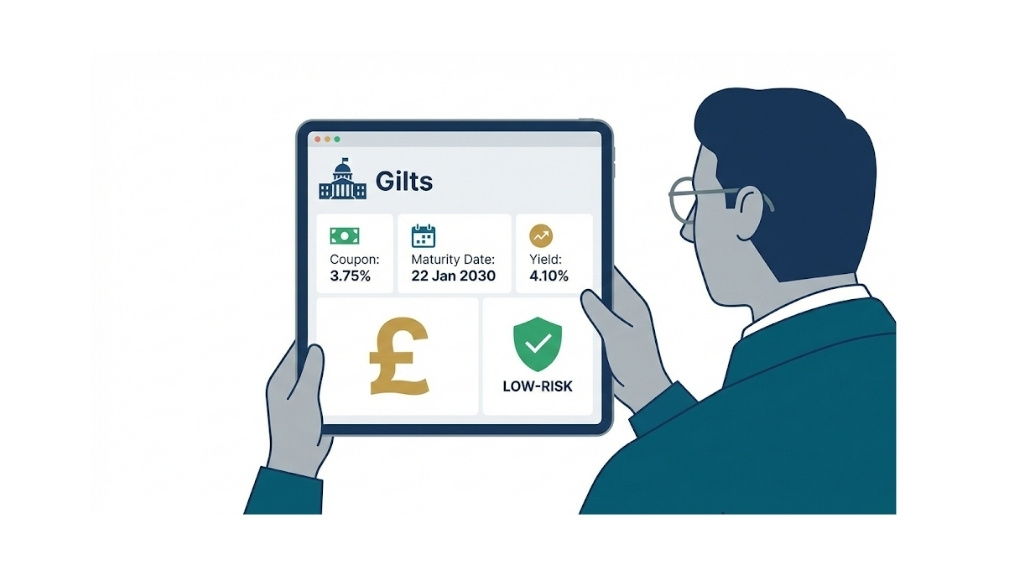
Gilts are UK government bonds. You can buy them through investment platforms like Hargreaves Lansdown, AJ Bell or Interactive Investor. Gilts pay a fixed coupon (interest) twice a year and return your capital at maturity. They are exempt from UK capital gains tax and can be held in an ISA or SIPP for fully tax-free returns. Alternatively, gilt ETFs like iShares Core UK Gilts (IGLT) offer instant diversification from as little as a few pounds.
UK government bonds, known as gilts, are one of the lowest-risk investments available to UK investors. When you buy a gilt, you are lending money to the UK government in exchange for regular interest payments and the return of your capital at a fixed date in the future.
Gilts have become increasingly popular with retail investors since yields rose significantly from 2022 onwards. With yields still attractive and platforms making it easier than ever to buy gilts online, they are a useful tool for income, capital preservation and portfolio diversification.
What Is a Gilt?
A gilt is a bond issued by the UK government through the Debt Management Office (DMO). The name comes from the gilt-edged certificates that were originally issued. Gilts are considered one of the safest investments because the UK government has never defaulted on its debt obligations (Source: DMO).
Every gilt has three key components:
Coupon: The annual interest rate, expressed as a percentage of the £100 face value. A 4% coupon pays £4 per year (usually in two semi-annual payments of £2). The coupon is fixed when the gilt is issued and does not change.
Maturity date: The date when the government repays the face value (£100 per unit) to the bondholder. Gilt maturities range from less than 1 year (short-dated) to over 50 years (ultra-long).
Price: Gilts trade on the London Stock Exchange and their price fluctuates. If a gilt trades at 95p, you pay £95 for £100 of face value. At maturity, you receive the full £100 regardless of what you paid. The difference between purchase price and face value is your capital gain or loss.
Types of Gilts
Conventional gilts: Pay a fixed coupon and return the £100 face value at maturity. The most common type.
Index-linked gilts: The coupon and principal are adjusted for inflation (using the Retail Prices Index). These protect your purchasing power but typically offer lower initial yields.
Key Takeaway: If you buy a gilt below face value and hold it to maturity, you receive a capital gain that is completely free from UK capital gains tax. This makes low-coupon gilts particularly tax-efficient outside an ISA.
How Gilt Prices and Yields Work
Gilt prices and interest rates move in opposite directions. When the Bank of England raises interest rates, existing gilt prices tend to fall (because newly issued gilts offer higher coupons, making older lower-coupon gilts less attractive). When rates fall, gilt prices tend to rise.
Running yield: The annual coupon divided by the current price. For example, a gilt with a 4% coupon trading at £105 has a running yield of 3.81% (4 / 105).
Yield to maturity (YTM): The total return if you hold the gilt until maturity, accounting for both coupon payments and any capital gain or loss. This is the most useful measure for buy-and-hold investors.
How to Buy Gilts in the UK: Step by Step
Step 1: Choose a Platform
Not all platforms offer individual gilts. The main UK brokers with gilt access are:
Best UK Platforms for Buying Gilts
| Platform | Individual Gilts? | Gilt ETFs? | Dealing Fee (Gilts) | ISA? |
|---|---|---|---|---|
| Hargreaves Lansdown | Yes (online + phone) | Yes | £11.95 online / 1% phone | Yes |
| Interactive Investor | Yes (online) | Yes | £3.99 | Yes |
| AJ Bell | Yes (online) | Yes | £5.00 | Yes |
| Freetrade | Yes (limited range) | Yes | Free | Yes (£59.88/yr) |
| Trading 212 | No | Yes | Free | Yes |
| Vanguard | No | Vanguard gilt ETFs only | Free | Yes |
Step 2: Decide Between Individual Gilts and Gilt ETFs
Individual gilts: You choose a specific gilt with a known coupon and maturity date. You know exactly what you will receive if you hold to maturity. Minimum investment is typically £100 (one unit at face value). Best for investors who want a fixed, predictable return.
Gilt ETFs: A fund that holds a diversified basket of gilts across different maturities. No fixed maturity date (the ETF continuously rolls maturing gilts into new ones). Better for investors who want easy diversification and the ability to invest small amounts. Popular options include iShares Core UK Gilts (IGLT, 0.07% OCF) and Vanguard UK Government Bond ETF (VGOV, 0.07% OCF).
Step 3: Open an Account
Open a stocks and shares ISA for tax-free income and gains. If you have already used your ISA allowance, a General Investment Account works too, as gilts are already exempt from CGT.
Step 4: Find and Buy Your Gilt
Gilts are named in a standard format: Treasury [coupon]% [maturity date]. For example, "Treasury 4% 2060" pays a 4% annual coupon and matures in 2060.
On your platform, search for the gilt by name or look at the gilt list. Check the current price, coupon, maturity date and yield to maturity. Place a market or limit order. Gilts settle on a T+1 basis (one business day after your order).
Key Takeaway: For most beginners, a gilt ETF like iShares Core UK Gilts (IGLT) is the simplest way to add gilt exposure to your portfolio. It requires no knowledge of individual gilt selection and can be bought from as little as a few pounds on most platforms.
Step 5: Understand Clean vs Dirty Pricing
The price you see quoted for a gilt is the clean price (excluding accrued interest). The price you actually pay is the dirty price (clean price plus accrued interest). If you buy a gilt between coupon dates, you compensate the seller for interest that has accumulated since the last payment. Your first coupon payment will then include the full amount, effectively reimbursing you.
Tax Rules for Gilts
Capital gains tax: Gilts are completely exempt from UK capital gains tax. This applies whether you sell before maturity or hold to maturity. This is a significant advantage over corporate bonds and shares (Source: HMRC).
Income tax: Coupon payments from gilts are subject to income tax at your marginal rate (20%, 40% or 45%) if held outside a tax wrapper. The personal savings allowance (£1,000 for basic rate, £500 for higher rate) may shelter some coupon income (Source: HMRC, 2025/26).
Inside an ISA: Both coupon income and any capital gains are completely tax-free. Holding gilts in an ISA shelters the coupon from income tax.
Inside a SIPP: Tax-free growth. Withdrawals taxed as income in retirement.
Low-coupon gilt strategy: Buying a gilt with a very low coupon at a discount to face value maximises your return through tax-free capital gain rather than taxable coupon income. This is a popular tax-planning strategy for higher-rate taxpayers holding gilts outside an ISA (Source: MoneySavingExpert, 2025).
Warning: While gilts are low risk if held to maturity, their price can fluctuate significantly in the secondary market, especially long-dated gilts. If you need to sell before maturity, you may receive less than you paid. Interest rate rises cause gilt prices to fall.
What Are the Risks of Buying Gilts?
Interest rate risk: If the Bank of England raises rates after you buy a gilt, its market price will fall. This only matters if you sell before maturity. If you hold to maturity, you receive the full face value regardless.
Inflation risk: Conventional gilts pay a fixed coupon. If inflation rises above your yield, your real return (after inflation) may be negative. Index-linked gilts mitigate this risk.
Opportunity cost: Gilts typically offer lower returns than equities over the long term. Money locked in gilts may miss out on higher growth from index funds or ETFs.
Liquidity: Individual gilts may have wider bid-ask spreads than gilt ETFs, particularly less popular issues. Gilt ETFs offer better liquidity for smaller investors.
Frequently Asked Questions
Are gilts a safe investment?
Gilts are considered one of the safest investments because they are backed by the UK government, which has never defaulted. However, their market price can fluctuate, and inflation can erode real returns. If held to maturity, you receive the full face value.
What is the minimum amount to buy gilts?
Individual gilts are traded in £100 units (face value), but you can buy them at a discount. Gilt ETFs can be bought for the price of one unit (typically £10 to £20) or less with fractional shares on some platforms.
Do gilts pay interest?
Yes. Gilts pay a fixed coupon, usually in two semi-annual payments. The coupon rate is set when the gilt is issued and does not change. For example, a gilt with a 4% coupon pays £2 every six months per £100 face value.
Can I hold gilts in an ISA?
Yes. You can hold both individual gilts and gilt ETFs inside a stocks and shares ISA. This makes all coupon income and any capital gains completely tax-free.
Do I pay capital gains tax on gilts?
No. Gilts are exempt from UK capital gains tax whether held inside or outside a tax wrapper. This is unique to gilts and is one of their key tax advantages.
What is the difference between a gilt and a corporate bond?
Gilts are issued by the UK government and considered very low risk. Corporate bonds are issued by companies and carry higher risk (the company could default). Corporate bonds typically offer higher yields to compensate for this additional risk. Gilts are CGT-free; qualifying corporate bonds may also be CGT-free.
Should I buy individual gilts or a gilt ETF?
Individual gilts give you a fixed return if held to maturity, but require larger investments and knowledge of gilt selection. Gilt ETFs offer instant diversification, easy trading and lower minimum investments. Most beginners start with a gilt ETF.
What happens when a gilt matures?
The UK government pays you the full face value (£100 per unit) plus the final coupon payment. The cash is credited to your brokerage account. There is no action required from you.
Are index-linked gilts better than conventional gilts?
Index-linked gilts protect against inflation by adjusting the coupon and principal with the Retail Prices Index. They offer lower initial yields but better protection if inflation rises above expectations. The choice depends on your inflation outlook.
How do gilt yields compare to savings accounts?
Gilt yields and savings rates are often similar, but the tax treatment differs. Gilt capital gains are tax-free, while savings interest is subject to income tax above the personal savings allowance. For higher-rate taxpayers, low-coupon gilts can offer better after-tax returns than savings accounts.
Related Reading
Explore more investing guides on Smart Investor UK:
- Best ETFs UK - Top ETF picks including gilt ETFs
- Best Index Funds UK - Top index fund picks
- How to Invest in Index Funds UK - Beginner's guide
- Stocks and Shares ISA Explained - Tax-free wrapper
- Capital Gains Tax on Shares UK - Tax rules for investors
- Best Trading Platforms UK - Compare brokers
- How to Start Investing UK - Complete beginner's guide
- Investing Strategies for Beginners - Build your approach
Smart Investor UK is editorially independent. Some links in this article are affiliate links, meaning we may earn a commission if you open an account, at no extra cost to you. This does not affect our editorial independence or the recommendations we make.
Capital at risk. The value of investments can go down as well as up. You may get back less than you invest. Tax treatment depends on individual circumstances and may change. This article does not constitute financial advice. If you are unsure about investing, seek independent financial advice.