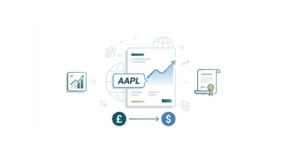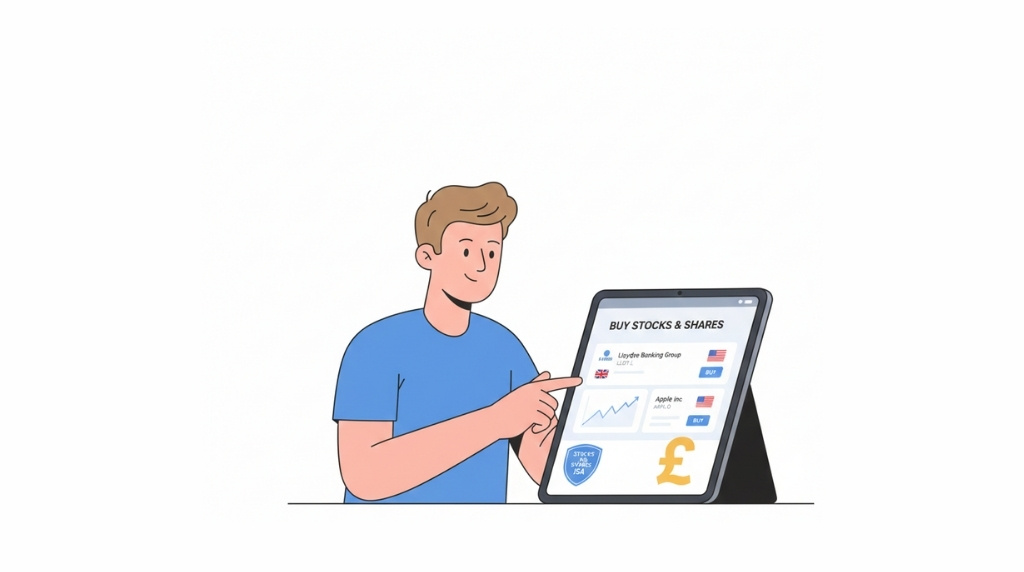
To buy stocks in the UK, open a Stocks and Shares ISA or investment account with an FCA-regulated platform like Trading 212, deposit money, search for the stock you want, and place a buy order. You can buy UK shares on the London Stock Exchange and US stocks on the NYSE and NASDAQ. Fractional shares let you buy a portion of expensive stocks from as little as 1 pound. Use an ISA to shelter your gains from tax.
What Are Stocks?
Stocks (also called shares or equities) represent ownership in a company. When you buy a stock, you own a small fraction of that business. If the company grows and becomes more profitable, the value of your stock typically rises. Many companies also pay dividends, which are regular cash payments to shareholders from the company's profits. For a detailed explanation of the difference between stocks and shares terminology, see our guide on how to buy shares UK.
In the UK, stocks are traded on exchanges including the London Stock Exchange (LSE) for UK companies and, through your broker, on the New York Stock Exchange (NYSE) and NASDAQ for US companies. You buy and sell stocks through an investment platform, which connects you to these exchanges.
How to Buy Stocks UK: Step by Step
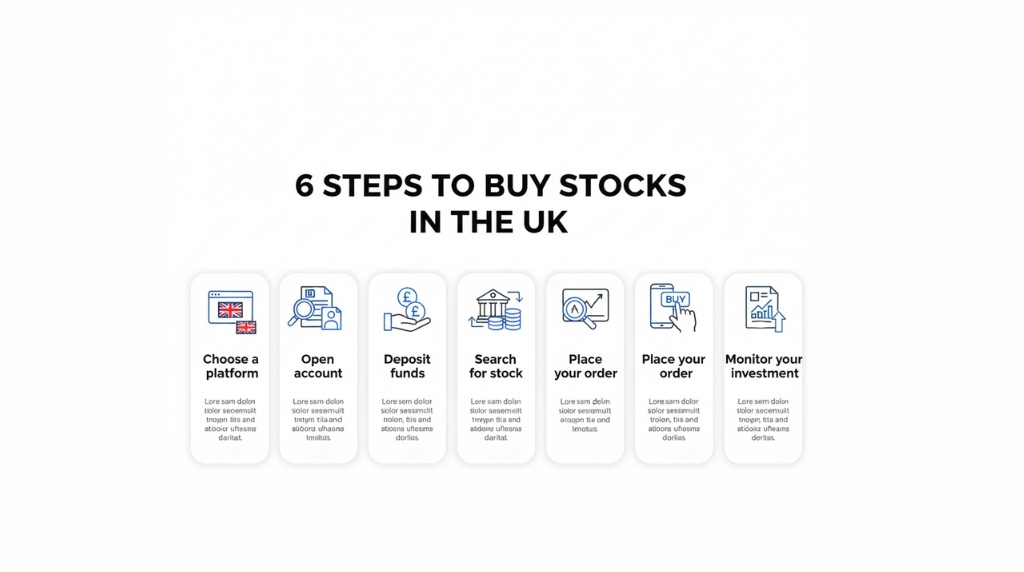
Step 1: Choose a Platform
You need an FCA-regulated investment platform (broker) to buy stocks. The platform holds your account, processes your trades, and keeps your investments safe. For beginners, the most important factors are low fees, an intuitive interface, and access to both UK and international markets.
| Platform | Commission | FX Fee | UK and US Stocks | Fractional Shares |
| Trading 212 | Zero | 0.15% | Yes | Yes (from 1 pound) |
| Freetrade | Zero | 0.99% | Yes | Yes |
| eToro | Zero | Approx 1.00% | Yes | Yes (from 10 dollars) |
| AJ Bell | 1.50-5.00 | 1.00% | Yes | No |
| Hargreaves L. | 11.95 | 1.00% | Yes | No |
| Interactive Inv. | 3.99 | 0.99% | Yes | No |
(Source: Platform websites, February 2026. See our full best trading platforms UK guide for detailed comparisons.)
Important: Platform fees and pricing can change. For example, Trading 212 currently lists free trading with a 0.15% FX fee on non-GBP securities, while eToro now says a 0.15% commission applies when opening and closing stock positions. Always check the provider’s latest pricing page before opening an account.
Step 2: Open an Account
Creating an account is fully online and typically takes less than 10 minutes. You will need to provide your full name, address, date of birth, National Insurance number, and upload photo ID (passport or driving licence). This identity verification is required by FCA regulations.
Choose a Stocks and Shares ISA if you want tax-free gains (recommended for most people), or a General Investment Account (GIA) if you have already used your 20,000 pound ISA allowance.
Step 3: Deposit Funds
Deposit money via bank transfer, debit card, Apple Pay, or Google Pay. Most platforms process deposits instantly or within minutes. Minimum deposits vary by platform, from zero on Trading 212 to 100 pounds on some traditional brokers.
Step 4: Search for the Stock
Use the platform's search bar to find the stock you want to buy. You can search by company name (for example, "Apple") or by ticker symbol (for example, "AAPL" for Apple on NASDAQ, or "SHEL" for Shell on the London Stock Exchange). Make sure you are buying the correct listing, as some companies trade on multiple exchanges.
Step 5: Place Your Order
Select the stock and choose the amount you want to invest. On platforms that support fractional shares, you can invest any amount from 1 pound. On platforms that only offer whole shares, you must buy at least one full share at the current market price.
Choose your order type. A market order buys the stock immediately at the current price. A limit order sets a maximum price you are willing to pay, and the order only executes if the stock reaches that price. For most beginners, a market order is the simplest option.
Step 6: Monitor Your Investment
Once your order is confirmed, the stock appears in your portfolio. You can track its performance, view any dividends received, and sell at any time during market hours. For long-term investing, checking monthly or quarterly is usually sufficient.
Costs of Buying Stocks in the UK
Understanding the costs involved helps you make informed decisions and avoid surprises.
| Cost | What It Is | Typical Amount |
| Trading Commission | Fee per trade charged by platform | Zero to 11.95 pounds |
| Platform Fee | Annual charge for holding account | Zero to 0.45% |
| FX Conversion Fee | Converting GBP to buy US stocks | 0.15% to 1.00% |
| Stamp Duty (UK shares) | HMRC tax on UK share purchases | 0.50% of purchase price |
| Spread | Gap between buy and sell price | Varies by stock |
Stamp duty of 0.50% applies to purchases of UK-listed shares and is collected automatically by your broker. It does not apply to ETFs, investment trusts, or AIM-listed shares. For more detail, see our guide on stamp duty on shares.
How to Buy US Stocks from the UK
Buying US stocks like Apple, Tesla, Amazon, and Nvidia from the UK is straightforward through any major platform. The process is the same as buying UK stocks, with a few additional considerations.
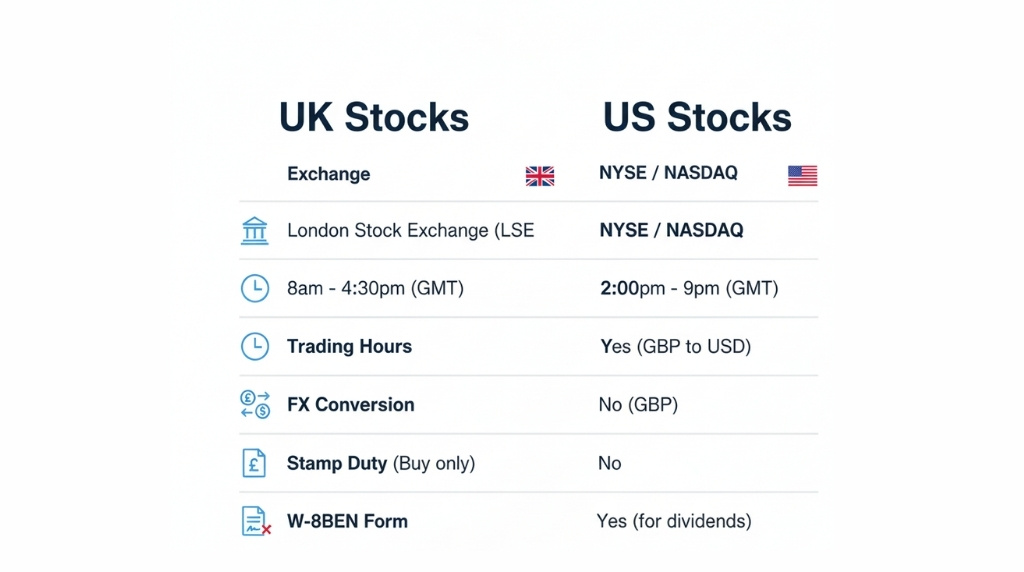
Your broker will charge an FX conversion fee (typically 0.15% to 1.00%) to convert your GBP into US dollars. US markets (NYSE and NASDAQ) are open from 2:30 PM to 9:00 PM UK time (GMT) and 1:30 PM to 8:00 PM during British Summer Time. You may need to complete a W-8BEN tax form (usually done digitally within the platform) to reduce US withholding tax on dividends from 30% to 15% under the UK-US tax treaty. No UK stamp duty applies to US stock purchases.
Buying Stocks Inside an ISA
Holding your stocks inside a Stocks and Shares ISA means all capital gains and dividends are completely tax-free. Outside an ISA, you would pay capital gains tax at 18% or 24% on profits above the 3,000 pound annual allowance, and dividend tax on dividends above 500 pounds.
The annual ISA allowance is 20,000 pounds for the 2025/26 tax year. If you plan to invest less than 20,000 pounds per year, there is almost no reason to use a GIA over an ISA.
Understanding Order Types
Market Order
A market order executes immediately at the best available price. This is the simplest order type and is suitable for most situations, particularly for liquid, large-cap stocks where the price is unlikely to move significantly between placing and executing the order.
Limit Order
A limit order sets a maximum price you are willing to pay (for a buy) or a minimum price you are willing to accept (for a sell). The order only executes if the stock reaches your specified price. This is useful if you want to buy a stock at a lower price than its current level.
Stop-Loss Order
A stop-loss order automatically sells your stock if it drops to a specified price. This can help limit losses, but be aware that in fast-moving markets the actual selling price may be lower than your stop price.
Tips for Buying Stocks
Diversify your portfolio across different companies, sectors, and geographies rather than putting everything into one stock. Consider mixing individual stocks with index funds or ETFs for a balanced approach.
Invest for the long term. Buying and selling stocks frequently (day trading) is statistically likely to lose you money. The longer you hold quality stocks, the greater your chances of positive returns.
Only invest money you can afford to lose. The value of individual stocks can fall significantly, sometimes to zero if a company fails. Never invest money you will need in the short term.
Do your research before buying. Understand what the company does, how it makes money, and whether its current price represents reasonable value. If research feels overwhelming, consider starting with diversified ETFs instead of picking individual stocks.
Frequently Asked Questions
How much money do I need to buy stocks in the UK?
You can buy stocks from as little as 1 pound on platforms that support fractional shares, such as Trading 212 and Freetrade. On platforms without fractional shares, you need enough to buy at least one whole share at the current market price.
Is buying stocks the same as buying shares?
In the UK, the terms "stocks" and "shares" are used interchangeably. Both refer to units of ownership in a company. "Shares" is the more common term in the UK, while "stocks" is more frequently used in the US. See our how to buy shares UK guide for more detail.
Do I pay tax when I buy stocks?
You pay 0.50% stamp duty when buying UK-listed shares. There is no stamp duty on US stocks, ETFs, or AIM shares. If your stocks are held inside a Stocks and Shares ISA, all gains and dividends are tax-free. Outside an ISA, you pay capital gains tax and dividend tax.
What is the best platform to buy stocks in the UK?
For zero-commission stock trading with fractional shares, Trading 212 is a strong choice. For the widest range of investments and in-depth research, Hargreaves Lansdown is popular. See our full best trading platforms UK comparison.
Can I buy US stocks from the UK?
Yes. Most UK platforms provide access to US stocks listed on the NYSE and NASDAQ. You will pay an FX conversion fee (typically 0.15% to 1.00%) and should complete a W-8BEN form for reduced US dividend withholding tax. See our guides on buying Tesla, Nvidia, Amazon, and Apple shares.
Should I buy individual stocks or funds?
For beginners, a diversified index fund or ETF is generally safer and simpler than picking individual stocks. Many investors use a core fund holding alongside a smaller allocation to individual stocks they believe in. See our how to start investing UK guide for a full beginner strategy.
What happens if a stock I own goes to zero?
If a company fails completely, its stock becomes worthless and you lose your entire investment in that company. This is why diversification is important. In a diversified portfolio, the loss of one holding is offset by gains in others.
Can I buy stocks inside an ISA?
Yes. A Stocks and Shares ISA lets you buy and hold stocks tax-free up to the 20,000 pound annual allowance. This is the most tax-efficient way to invest in stocks for most UK residents.
What is the difference between the LSE and AIM?
The London Stock Exchange (LSE) main market lists larger, established companies like those in the FTSE 100 and FTSE 250. AIM (Alternative Investment Market) lists smaller, growth-focused companies. AIM shares are generally higher risk and more volatile, but they are exempt from stamp duty and may qualify for certain inheritance tax reliefs.
How quickly can I sell stocks?
You can sell stocks at any time during market hours. UK market hours are 8:00 AM to 4:30 PM (GMT). US market hours are 2:30 PM to 9:00 PM (GMT). Settlement (when you receive the cash) typically takes two business days (T+2).
Related Reading
Capital Gains Tax on Shares UK
What Are Stocks?
Stocks (also called shares or equities) represent ownership in a company. When you buy a stock, you own a small fraction of that business. If the company grows and becomes more profitable, the value of your stock typically rises. Many companies also pay dividends, which are regular cash payments to shareholders from the company's profits. For a detailed explanation of the difference between stocks and shares terminology, see our guide on how to buy shares UK.
In the UK, stocks are traded on exchanges including the London Stock Exchange (LSE) for UK companies and, through your broker, on the New York Stock Exchange (NYSE) and NASDAQ for US companies. You buy and sell stocks through an investment platform, which connects you to these exchanges.
How to Buy Stocks UK: Step by Step
Step 1: Choose a Platform
You need an FCA-regulated investment platform (broker) to buy stocks. The platform holds your account, processes your trades, and keeps your investments safe. For beginners, the most important factors are low fees, an intuitive interface, and access to both UK and international markets.
| Platform | Commission | FX Fee | UK and US Stocks | Fractional Shares |
| Trading 212 | Zero | 0.15% | Yes | Yes (from 1 pound) |
| Freetrade | Zero | 0.99% | Yes | Yes |
| eToro | Zero | Approx 1.00% | Yes | Yes (from 10 dollars) |
| AJ Bell | 1.50-5.00 | 1.00% | Yes | No |
| Hargreaves L. | 11.95 | 1.00% | Yes | No |
| Interactive Inv. | 3.99 | 0.99% | Yes | No |
(Source: Platform websites, February 2026. See our full best trading platforms UK guide for detailed comparisons.)
Step 2: Open an Account
Creating an account is fully online and typically takes less than 10 minutes. You will need to provide your full name, address, date of birth, National Insurance number, and upload photo ID (passport or driving licence). This identity verification is required by FCA regulations.
Choose a Stocks and Shares ISA if you want tax-free gains (recommended for most people), or a General Investment Account (GIA) if you have already used your 20,000 pound ISA allowance.
Step 3: Deposit Funds
Deposit money via bank transfer, debit card, Apple Pay, or Google Pay. Most platforms process deposits instantly or within minutes. Minimum deposits vary by platform, from zero on Trading 212 to 100 pounds on some traditional brokers.
Step 4: Search for the Stock
Use the platform's search bar to find the stock you want to buy. You can search by company name (for example, "Apple") or by ticker symbol (for example, "AAPL" for Apple on NASDAQ, or "SHEL" for Shell on the London Stock Exchange). Make sure you are buying the correct listing, as some companies trade on multiple exchanges.
Step 5: Place Your Order
Select the stock and choose the amount you want to invest. On platforms that support fractional shares, you can invest any amount from 1 pound. On platforms that only offer whole shares, you must buy at least one full share at the current market price.
Choose your order type. A market order buys the stock immediately at the current price. A limit order sets a maximum price you are willing to pay, and the order only executes if the stock reaches that price. For most beginners, a market order is the simplest option.
Step 6: Monitor Your Investment
Once your order is confirmed, the stock appears in your portfolio. You can track its performance, view any dividends received, and sell at any time during market hours. For long-term investing, checking monthly or quarterly is usually sufficient.
Costs of Buying Stocks in the UK
Understanding the costs involved helps you make informed decisions and avoid surprises.
| Cost | What It Is | Typical Amount |
| Trading Commission | Fee per trade charged by platform | Zero to 11.95 pounds |
| Platform Fee | Annual charge for holding account | Zero to 0.45% |
| FX Conversion Fee | Converting GBP to buy US stocks | 0.15% to 1.00% |
| Stamp Duty (UK shares) | HMRC tax on UK share purchases | 0.50% of purchase price |
| Spread | Gap between buy and sell price | Varies by stock |
Stamp duty of 0.5% generally applies when you buy UK shares and is usually collected automatically by your broker. It does not apply to US shares.For more detail, see our guide on stamp duty on shares.
How to Buy US Stocks from the UK
Buying US stocks like Apple, Tesla, Amazon, and Nvidia from the UK is straightforward through any major platform. The process is the same as buying UK stocks, with a few additional considerations.
Your broker will charge an FX conversion fee (typically 0.15% to 1.00%) to convert your GBP into US dollars. US markets (NYSE and NASDAQ) are open from 2:30 PM to 9:00 PM UK time (GMT) and 1:30 PM to 8:00 PM during British Summer Time. You may need to complete a W-8BEN tax form (usually done digitally within the platform) to reduce US withholding tax on dividends from 30% to 15% under the UK-US tax treaty. No UK stamp duty applies to US stock purchases.
Buying Stocks Inside an ISA
Holding your stocks inside a Stocks and Shares ISA means all capital gains and dividends are completely tax-free. Outside an ISA, you would pay capital gains tax at 18% or 24% on profits above the 3,000 pound annual allowance, and dividend tax on dividends above 500 pounds.
The annual ISA allowance is 20,000 pounds for the 2025/26 tax year. If you plan to invest less than 20,000 pounds per year, there is almost no reason to use a GIA over an ISA.
Understanding Order Types
Market Order
A market order executes immediately at the best available price. This is the simplest order type and is suitable for most situations, particularly for liquid, large-cap stocks where the price is unlikely to move significantly between placing and executing the order.
Limit Order
A limit order sets a maximum price you are willing to pay (for a buy) or a minimum price you are willing to accept (for a sell). The order only executes if the stock reaches your specified price. This is useful if you want to buy a stock at a lower price than its current level.
Stop-Loss Order
A stop-loss order automatically sells your stock if it drops to a specified price. This can help limit losses, but be aware that in fast-moving markets the actual selling price may be lower than your stop price.
Tips for Buying Stocks
Diversify your portfolio across different companies, sectors, and geographies rather than putting everything into one stock. Consider mixing individual stocks with index funds or ETFs for a balanced approach.
Invest for the long term. Buying and selling stocks frequently (day trading) is statistically likely to lose you money. The longer you hold quality stocks, the greater your chances of positive returns.
Only invest money you can afford to lose. The value of individual stocks can fall significantly, sometimes to zero if a company fails. Never invest money you will need in the short term.
Do your research before buying. Understand what the company does, how it makes money, and whether its current price represents reasonable value. If research feels overwhelming, consider starting with diversified ETFs instead of picking individual stocks.
Frequently Asked Questions
How much money do I need to buy stocks in the UK?
You can buy stocks from as little as 1 pound on platforms that support fractional shares, such as Trading 212 and Freetrade. On platforms without fractional shares, you need enough to buy at least one whole share at the current market price.
Is buying stocks the same as buying shares?
In the UK, the terms "stocks" and "shares" are used interchangeably. Both refer to units of ownership in a company. "Shares" is the more common term in the UK, while "stocks" is more frequently used in the US. See our how to buy shares UK guide for more detail.
Do I pay tax when I buy stocks?
You pay 0.50% stamp duty when buying UK-listed shares. There is no stamp duty on US stocks, ETFs, or AIM shares. If your stocks are held inside a Stocks and Shares ISA, all gains and dividends are tax-free. Outside an ISA, you pay capital gains tax and dividend tax.
What is the best platform to buy stocks in the UK?
For zero-commission stock trading with fractional shares, Trading 212 is a strong choice. For the widest range of investments and in-depth research, Hargreaves Lansdown is popular. See our full best trading platforms UK comparison.
Can I buy US stocks from the UK?
Yes. Most UK platforms provide access to US stocks listed on the NYSE and NASDAQ. You will pay an FX conversion fee (typically 0.15% to 1.00%) and should complete a W-8BEN form for reduced US dividend withholding tax. See our guides on buying Tesla, Nvidia, Amazon, and Apple shares.
Should I buy individual stocks or funds?
For beginners, a diversified index fund or ETF is generally safer and simpler than picking individual stocks. Many investors use a core fund holding alongside a smaller allocation to individual stocks they believe in. See our how to start investing UK guide for a full beginner strategy.
What happens if a stock I own goes to zero?
If a company fails completely, its stock becomes worthless and you lose your entire investment in that company. This is why diversification is important. In a diversified portfolio, the loss of one holding is offset by gains in others.
Can I buy stocks inside an ISA?
Yes. A Stocks and Shares ISA lets you buy and hold stocks tax-free up to the 20,000 pound annual allowance. This is the most tax-efficient way to invest in stocks for most UK residents.
What is the difference between the LSE and AIM?
The London Stock Exchange (LSE) main market lists larger, established companies like those in the FTSE 100 and FTSE 250. AIM (Alternative Investment Market) lists smaller, growth-focused companies. AIM shares are generally higher risk and more volatile, but they are exempt from stamp duty and may qualify for certain inheritance tax reliefs.
How quickly can I sell stocks?
You can sell stocks at any time during market hours. UK market hours are 8:00 AM to 4:30 PM (GMT). US market hours are 2:30 PM to 9:00 PM (GMT). Settlement (when you receive the cash) is currently typically two business days (T+2) in the UK. The UK is scheduled to move to T+1 on 11 October 2027.
Related Reading
Capital Gains Tax on Shares UK
Capital at risk. The value of your investments can go down as well as up. You may get back less than you invest. Tax treatment depends on your individual circumstances and may change in the future. ISA rules and allowances may also change. If you are unsure whether investing is right for you, seek independent financial advice.