UK investors can buy gold through ETFs in a Stocks and Shares ISA (from 0.12% per year), CGT-exempt Royal Mint coins (Sovereigns and Britannias), digital gold via the Royal Mint's DigiGold platform (from £25), or physical gold bars from LBMA-accredited dealers. Gold surged over 50% in 2025 and has delivered an average annualised return of approximately 10.9% over the past 25 years. For most beginners, a low-cost gold ETC like iShares Physical Gold (SGLN) held inside an ISA offers the simplest, most tax-efficient route.
Why Invest in Gold?
Gold has been a store of value for thousands of years, and its role in modern portfolios remains as relevant as ever. In 2025, the gold price climbed over 50% in sterling terms, reaching record highs above £3,350 per ounce by December (Exchange-rates.org, 2025 UK Gold Price Data). Global demand hit 5,002 tonnes during the year, driven by central bank purchases, geopolitical instability, and surging investor interest (World Gold Council, Gold Demand Trends 2025).
There are three core reasons UK investors allocate a portion of their portfolio to gold.
Inflation Hedge
Gold has historically maintained its purchasing power over long periods. While cash savings have been eroded by inflation in recent years, gold priced in sterling has risen from roughly £180 per ounce in 2000 to over £3,400 in early 2026, an increase of more than 1,700%.
Portfolio Diversification
Gold tends to move independently of equities and bonds. During the 2008 financial crisis, while the FTSE 100 fell roughly 30%, gold rose by over 40% in sterling terms. This low correlation makes it a useful diversifier that can reduce overall portfolio volatility.
Safe Haven in Uncertainty
During periods of geopolitical tension, currency weakness, or stock market turbulence, investors typically flock to gold. Central banks purchased over 860 tonnes of gold in 2025, continuing a multi-year trend of reserve diversification away from the US dollar (World Gold Council, 2025).

- Gold does not pay dividends or generate income. Its value comes from capital appreciation and its role as a portfolio stabiliser.
- Most financial planners suggest allocating between 5% and 10% of a diversified portfolio to gold.
6 Ways to Invest in Gold in the UK
There are several ways to gain exposure to gold as a UK investor. Each method has different costs, tax implications, and levels of convenience.
1. Gold ETFs and ETCs (Exchange-Traded Commodities)
Gold ETFs and ETCs are funds that track the spot price of gold. They trade on the London Stock Exchange and can be bought through any UK investment platform, just like shares. The most popular options for UK investors:
Gold ETC options
| Gold ETC | Ticker | Annual Fee (TER) | Currency | Physical Gold |
|---|---|---|---|---|
| iShares Physical Gold ETC | SGLN | 0.12% | GBP | Yes |
| Invesco Physical Gold ETC | SGLD | 0.12% | USD | Yes |
| WisdomTree Physical Gold | PHAU | 0.39% | USD | Yes |
| WisdomTree Physical Gold (GBP Hedged) | PHGP | 0.39% | GBP | Yes |
How it works: When you buy shares in iShares Physical Gold ETC, for example, your money is backed by real gold bars stored in secure London vaults by JPMorgan. The fund simply tracks the gold spot price minus its small annual fee.
Best for: Beginners who want easy, low-cost access to gold. Can be held in a Stocks and Shares ISA for completely tax-free gains.

2. CGT-Exempt Gold Coins (Sovereigns and Britannias)
All gold coins produced by the Royal Mint that carry a face value are classified as UK legal tender. Under HMRC rules (TCGA92/S21(1)(b)), sterling currency is not an asset for capital gains purposes. This means profits on these coins are entirely free from Capital Gains Tax, regardless of the amount.
Gold coin sizes and approximate prices
| Coin | Weight | Gold Content | Approx. Price (Feb 2026) |
|---|---|---|---|
| Gold Sovereign | 7.98g | 7.32g (22ct) | £540 |
| Half Sovereign | 3.99g | 3.66g (22ct) | £275 |
| 1oz Gold Britannia | 31.1g | 31.1g (24ct) | £3,500 |
| 1/4oz Gold Britannia | 7.78g | 7.78g (24ct) | £900 |
Important: Investment gold (including coins and bars) is VAT-free in the UK. However, silver and platinum bullion attract 20% VAT.
Best for: Larger investors and those concerned about CGT. Particularly attractive now that the annual CGT allowance has been cut to just £3,000 for 2025/26.

3. Royal Mint DigiGold
DigiGold is the Royal Mint's digital gold platform, allowing you to buy fractional ownership of large 400oz gold bars stored in The Vault, the Royal Mint's secure on-site storage facility.
- Minimum purchase: £25
- Storage fee: 0.5% + VAT per year
- Buy and sell 24/7, 365 days a year
- Backed by LBMA-approved investment-grade gold bars
- Full legal ownership (Royal Mint acts as custodian only)
- Not FCA-regulated (no FSCS protection)
- Subject to Capital Gains Tax
Best for: Beginners who want to start small and own real physical gold without the hassle of storage.
4. Physical Gold Bars
Gold bars are available from LBMA-accredited dealers in sizes ranging from 1g to 1kg. Popular UK dealers include BullionByPost, The Royal Mint, GOLD.co.uk, and Sharps Pixley. Bars are VAT-free but subject to Capital Gains Tax. They require secure storage (home safe, bank vault, or dealer storage) and insurance if stored at home.
Best for: Investors who want direct physical ownership and are comfortable managing storage and security.
5. Gold in a SIPP (Pension)
Since 2006, the UK government has allowed SIPP holders to invest in physical gold bullion. Gold held within a SIPP benefits from income tax relief on contributions (up to 45% for higher-rate taxpayers) and is completely free from Capital Gains Tax.
HMRC rules require the gold to be investment-grade bars with a minimum purity of 995, stored in an approved secure vault. Gold coins do not qualify. Not all SIPP providers permit physical gold holdings, so check before transferring. Alternatively, most SIPP providers allow gold ETCs within your pension, which is a simpler route.
Best for: Long-term retirement investors who want tax-efficient gold exposure alongside other pension investments.
6. Gold Mining Shares and Funds
Rather than buying gold itself, you can invest in companies that mine it. Gold mining shares tend to amplify gold price movements, both upward and downward. Options include individual mining shares (e.g. Fresnillo, Endeavour Mining), the L&G Gold Mining UCITS ETF, or actively managed gold funds available on major UK platforms.
Best for: Experienced investors comfortable with higher volatility who want leveraged exposure to the gold price.
- For most UK beginners, a gold ETC inside a Stocks and Shares ISA is the simplest and most tax-efficient starting point.
- CGT-exempt coins are ideal for larger investors who want to avoid the now very low £3,000 annual CGT allowance.
How to Buy Gold in the UK: Step by Step
Step 1: Decide How Much to Allocate
Most financial planners suggest between 5% and 10% of your overall portfolio. Gold does not generate income, so overweighting it means missing out on dividends and interest from equities and bonds.
Step 2: Choose Your Method
Use the comparison table below to decide which approach suits you best:
Ways to invest in gold (UK)
| Method | Min. Investment | Annual Costs | CGT Liability | ISA Eligible | Ease |
|---|---|---|---|---|---|
| Gold ETC (e.g. SGLN) | £1+ | 0.12% TER + platform | Free in ISA | Yes | Very easy |
| CGT-Exempt Coins | £275 | Storage (if vaulted) | Exempt | No | Moderate |
| DigiGold | £25 | 0.5% + VAT | Subject to CGT | No | Easy |
| Physical Bars | £80 (1g) | Storage + insurance | Subject to CGT | No | Moderate |
| Gold in SIPP | Provider min. | SIPP fees + storage | Free in SIPP | N/A | Complex |
| Mining Shares/ETFs | £1+ | Fund TER + platform | Free in ISA | Yes | Easy |
Step 3: Open an Account
For gold ETCs, open a Stocks and Shares ISA with a platform like Trading 212 (commission-free), InvestEngine (0% platform fee for ETFs), or Vanguard (0.15% annual fee). Search for the gold ETC by name or ticker, place your order, and the shares appear in your account instantly.
Step 4: Make Your Purchase
Consider drip-feeding your investment over several months rather than buying all at once. This approach, known as pound-cost averaging, reduces the risk of buying at a short-term peak.
Step 5: Store Securely (Physical Gold Only)
If you buy coins or bars for home delivery, invest in a high-quality safe and appropriate insurance. Alternatively, use a dealer's vaulting service. BullionByPost charges from 0.4% + VAT per year for allocated, insured storage.
Tax Rules for Gold Investments in the UK
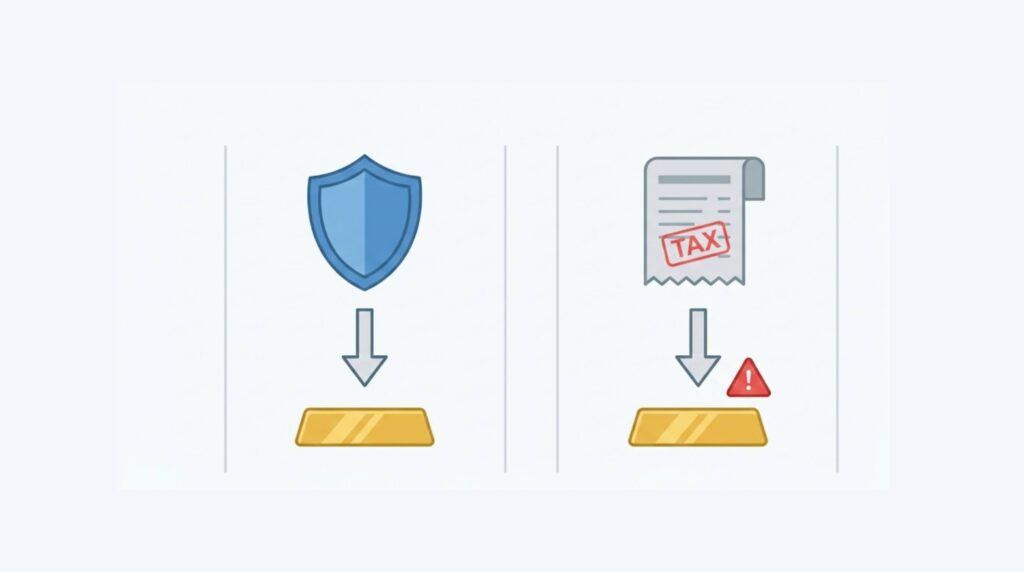
Understanding the tax treatment of gold is critical, especially since the CGT annual allowance dropped to just £3,000 for 2025/26. Here is how each investment type is taxed. For full details, see our Capital Gains Tax on Shares UK guide.
Gold investing tax treatment (UK)
| Investment Type | Income Tax | Capital Gains Tax | VAT on Purchase |
|---|---|---|---|
| Gold ETC in ISA | None | None | N/A |
| Gold ETC in GIA | None | 18% / 24% on gains over £3,000 | N/A |
| Gold ETC in SIPP | None | None | N/A |
| Royal Mint Coins | None | Exempt (UK legal tender) | None (VAT-free) |
| Gold Bars | None | 18% / 24% on gains over £3,000 | None (VAT-free) |
| DigiGold | None | 18% / 24% on gains over £3,000 | None (VAT-free) |
| Mining Shares in ISA | None | None | N/A |
CGT Worked Example
Suppose you bought £10,000 of gold bars in 2020 and sold them in 2026 for £22,000, making a £12,000 gain. As a higher-rate taxpayer:
- Annual CGT allowance: £3,000
- Taxable gain: £12,000 - £3,000 = £9,000
- CGT at 24%: £9,000 x 24% = £2,160
If you had bought CGT-exempt Sovereigns instead, the entire £12,000 profit would be tax-free, saving you £2,160.
- With the CGT allowance now at just £3,000, tax planning matters more than ever for gold investors.
- Holding gold ETCs inside an ISA or buying CGT-exempt coins are the two most tax-efficient strategies.
Gold Price Performance: What History Tells Us
Gold has been one of the strongest performing asset classes over the past two decades.
Gold performance in GBP
| Period | Approx. Return (GBP) |
|---|---|
| 2000-2025 (25 years) | 1,700%+ total |
| 2015-2025 (10 years) | 250%+ |
| 2025 calendar year | 53% |
| 2020-2025 (5 years) | 140%+ |
Gold priced in sterling has delivered exceptional returns over the past 25 years. UK investors have benefited from a double tailwind: a rising gold price and a weakening pound against the dollar, since gold is priced globally in US dollars.
2025 in context: Gold's roughly 53% gain in sterling during 2025 was its strongest annual performance since 1979. The rally was driven by US-China trade tensions, central bank purchases exceeding 860 tonnes, record ETF inflows, and a weakening US dollar (J.P. Morgan Global Research, 2025).
2026 outlook: Major institutions forecast gold trading between approximately £3,100 and £4,100 per ounce in 2026, with J.P. Morgan projecting prices could reach around £3,850/oz by Q4 2026. Central bank buying is expected to remain elevated at around 755 tonnes (J.P. Morgan, State Street, World Gold Council).
Warning: Past performance is not a guarantee of future returns. Gold can be volatile in the short term and has experienced significant drawdowns, including a roughly 45% decline from its 2011 peak to its 2015 low.
Gold vs Other UK Investments
How does gold stack up against other popular UK investments?
Asset class comparison (UK)
| Asset Class | 10-Year Approx. Return | Income | Volatility | Tax Efficiency |
|---|---|---|---|---|
| Gold (physical/ETC) | 200%+ | None | Moderate | CGT-exempt coins, ISA for ETCs |
| FTSE 100 (inc. dividends) | 80–100% | 3.5% yield | Mod-High | ISA eligible |
| S&P 500 (in GBP) | 250%+ | 1.3% yield | Mod-High | ISA eligible |
| UK Gov Bonds (Gilts) | 10–20% | Coupon payments | Low | ISA eligible |
| Cash Savings | 15–25% | Interest | None | Up to £1,000 PSA |
| UK Property | 40–60% | Rental income | Low-Mod | Complex |
- Gold has outperformed most traditional UK asset classes over the past decade, but unlike equities and bonds, it produces no income.
- It works best as a complement to, not a replacement for, a diversified portfolio of income-generating investments.
Risks of Investing in Gold
Before investing, consider these risks carefully:
No income generation. Gold does not pay dividends, interest, or rent. Your return depends entirely on the price going up.
Short-term volatility. Despite its reputation as a safe haven, gold can experience sharp drops. Between 2011 and 2015, gold lost roughly 45% of its value.
Storage and insurance costs. Physical gold requires secure storage. Home storage carries theft risk; vault storage typically costs 0.4% to 1% per year.
Counterparty risk with ETCs. Gold ETCs are technically debt instruments, not funds. If the issuer defaults, your claim is on the physical gold backing the ETC, but the legal structure differs from holding gold directly.
Currency risk. Gold is priced globally in US dollars. If the pound strengthens significantly, your sterling-denominated returns will be reduced, even if the underlying gold price holds steady.
Opportunity cost. Money in gold is money not invested in dividend-paying shares, interest-bearing bonds, or other productive assets.
Frequently Asked Questions
Gold continues to benefit from structural tailwinds including central bank buying, geopolitical uncertainty, and potential interest rate cuts. Major institutions forecast prices between approximately £3,100 and £4,100 per ounce for 2026. However, after a 55%+ gain in 2025, short-term pullbacks are possible. Consider pound-cost averaging rather than investing a lump sum.
You cannot hold physical gold in an ISA. However, you can hold gold ETCs such as iShares Physical Gold (SGLN) inside a Stocks and Shares ISA, which makes any gains completely tax-free.
It depends on how you invest. Gold ETCs in an ISA or SIPP are tax-free. CGT-exempt coins (Sovereigns, Britannias) are always tax-free. Gold bars, DigiGold, and ETCs held outside an ISA are subject to CGT at 18% (basic rate) or 24% (higher rate) on gains exceeding the £3,000 annual allowance. See our full Capital Gains Tax guide for details.
A gold ETC like iShares Physical Gold (0.12% annual fee) held on a commission-free platform like Trading 212 is the cheapest option. For physical gold, the Royal Mint's DigiGold starts from £25 with a 0.5% + VAT annual storage fee.
Most financial planners recommend between 5% and 10%. Gold works best as a diversifier and inflation hedge alongside equities, bonds, and other assets. For a broader framework, see our guide on how to start investing in the UK.
Investment gold (bars and coins) is VAT-free in the UK. This includes all gold bullion coins and bars of at least 99.5% purity. Silver and platinum bullion, however, attract 20% VAT.
Yes. Gold Sovereigns minted from 1837 onwards, Gold Britannias, and all other Royal Mint bullion coins classified as UK legal tender are completely exempt from Capital Gains Tax under HMRC rules (TCGA92/S21(1)(b)).
Yes. Physical gold bullion (minimum 995 purity, bar form only) can be held in a SIPP or SSAS. Alternatively, you can invest in gold ETCs within most SIPPs. Gold in a pension benefits from income tax relief on contributions and is free from CGT. Compare options in our best SIPP provider UK guide.
For ETCs: Trading 212, InvestEngine, or Vanguard. For coins and bars: The Royal Mint, BullionByPost, or GOLD.co.uk. For digital gold: Royal Mint DigiGold. Always use LBMA-accredited dealers for physical gold.
Coins are generally better for UK investors because Royal Mint coins are CGT-exempt while bars are not. Coins also offer greater flexibility for selling in smaller amounts. Bars have slightly lower premiums per gram but this saving is typically outweighed by the CGT advantage of coins.
Related Reading
Explore more investing guides on Smart Investor UK:
- How to Start Investing in the UK - Complete beginner's guide
- Best Stocks and Shares ISA - Compare ISA platforms for holding gold ETCs
- Capital Gains Tax on Shares UK - Full guide to CGT rules
- How to Invest in the S&P 500 UK - Another popular investment for beginners
- Best SIPP Provider UK - Compare SIPPs for gold pension investing
- How to Buy Shares UK - Step-by-step share buying guide
- ISA Allowance 2025/26 - Current ISA limits and rules
- Dividend Tax UK - How dividends are taxed
Smart Investor UK is editorially independent. Some links in this article are affiliate links, meaning we may earn a commission if you open an account, at no extra cost to you. This never influences our recommendations. Contact: hello@smartinvestoruk.co.uk
Capital at risk. The value of investments can go down as well as up. You may get back less than you invest. Tax treatment depends on individual circumstances and may change in the future. This article does not constitute personal financial advice.