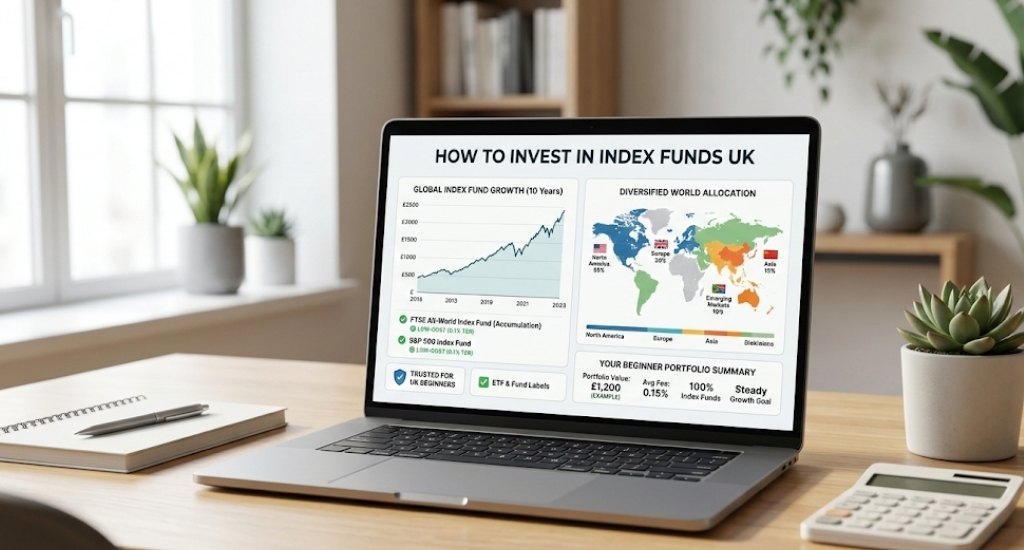
To invest in index funds in the UK, open a Stocks and Shares ISA with an FCA-regulated platform, choose a low-cost index fund that tracks a broad market (such as a global tracker or FTSE 100 fund), and invest regularly. Index funds typically charge 0.05% to 0.25% per year, making them one of the cheapest ways to build a diversified portfolio. For most beginners, a single global index fund is all you need to get started.
What Is an Index Fund?
An index fund is a type of investment fund that automatically tracks a market index, such as the FTSE 100, FTSE All-Share, S&P 500 or MSCI World. Instead of a fund manager picking individual stocks and trying to beat the market, an index fund simply mirrors the index by holding the same shares in the same proportions.
This passive approach keeps costs very low (typically 0.05% to 0.25% per year, compared to 0.75% to 1.5% for actively managed funds) and has historically delivered better returns than most actively managed funds over the long term. Research consistently shows that the majority of active fund managers fail to beat their benchmark index after fees.
(Source: SPIVA Europe Scorecard 2025, S&P Dow Jones Indices.)
What Is the Difference Between Index Funds and ETFs?
Index funds come in two main structures. Both track the same indices, but they work slightly differently:
| Feature | Index Fund (OEIC/Unit Trust) | Index ETF |
| How you buy | Through a platform, priced once daily | Traded on stock exchange like a share |
| Pricing | Once per day (forward pricing) | Real-time throughout the day |
| Minimum investment | Often 100 to 500 pounds (or 25 pounds/month) | From 1 pound with fractional shares |
| Ongoing costs | 0.05% to 0.25% | 0.03% to 0.25% |
| Availability | Platform-dependent | Available on most platforms |
| Best for | Hands-off monthly investing | Flexibility and lower minimums |
For most UK beginners, both options work well. If you want to set up a monthly direct debit and forget about it, traditional index funds (OEICs) are simple. If you prefer lower minimums and real-time trading, ETFs are a great choice. For a detailed comparison, see our guide to best index funds UK.
What Are the Most Popular UK Index Funds in 2026?
| Fund Name | Index Tracked | Ongoing Cost | What It Covers |
| Vanguard FTSE Global All Cap | FTSE Global All Cap | 0.23% | 7,000+ stocks worldwide (developed + emerging) |
| Vanguard FTSE 100 | FTSE 100 | 0.06% | 100 largest UK companies |
| HSBC FTSE All-World Index | FTSE All-World | 0.13% | 4,000+ stocks worldwide |
| Fidelity Index World | MSCI World | 0.12% | 1,400+ developed market stocks |
| L&G UK Index | FTSE All-Share | 0.04% | ~600 UK companies (large, mid, small) |
| iShares Core S&P 500 ETF (CSP1) | S&P 500 | 0.07% | 500 largest US companies |
| Vanguard S&P 500 ETF (VUAG) | S&P 500 | 0.07% | 500 largest US companies (accumulating) |
| Vanguard FTSE All-World ETF (VWRP) | FTSE All-World | 0.22% | 4,000+ stocks worldwide (accumulating) |
(Source: Fund factsheets, February 2026. Ongoing costs are annual fund management charges and do not include platform fees.)
How Do You Buy Index Funds in the UK?
Step 1: Choose a platform.
Open an account with an FCA-regulated investment platform. For index funds specifically, good options include Vanguard (own funds only, low cost), InvestEngine (free ETF investing), Trading 212 (commission-free, wide range) and AJ Bell (broad fund and ETF selection).
Step 2: Open a Stocks and Shares ISA.
This shelters your investments from capital gains tax and dividend tax. You can invest up to 20,000 pounds per tax year. See ISA rules.
Step 3: Deposit money.
Transfer funds via bank transfer or debit card. Many platforms let you set up a monthly direct debit.
Step 4: Search for your chosen fund.
Use the fund name or ticker code (for example, VWRP for Vanguard FTSE All-World ETF or CSP1 for iShares Core S&P 500).
Step 5: Buy the fund.
Enter the amount you want to invest and confirm the purchase. With ETFs, you place an order like buying a share. With OEICs, you enter a pound amount and the platform buys at the next dealing point.
Step 6: Set up regular investing.
Automating monthly contributions smooths out market volatility through pound-cost averaging and builds the habit of consistent investing.
Where Can You Buy Index Funds in the UK?
| Platform | Platform Fee | Fund Dealing | ETF Dealing | Best For |
| Trading 212 | 0% | N/A (ETFs only) | Free | Free ETF investing |
| InvestEngine | 0% (DIY) | N/A (ETFs only) | Free | Free ETF portfolios |
| Vanguard | 0.15% (max 375 pounds/year) | Free | Free | Vanguard index funds |
| AJ Bell | 0.25% | 1.50 pounds | 1.50 pounds | Broad fund and ETF range |
| Hargreaves Lansdown | 0.45% | Free | 11.95 pounds | Widest fund selection |
| Interactive Investor | From 5.99 pounds/month | Free (1/month) | Free (1/month) | Flat fee, larger portfolios |
| Freetrade | Free (Plus: 4.99 pounds/month for ISA) | N/A | Free | Simple app, low cost |
(Source: Provider websites, February 2026. Fees may vary by account type.)
How Do You Choose the Right Index Fund?
Global diversification: A single global tracker fund (like Vanguard FTSE Global All Cap or HSBC FTSE All-World) gives you exposure to thousands of companies across developed and emerging markets. This is the simplest starting point for most investors.
UK-focused: If you want exposure specifically to UK companies, FTSE 100 or FTSE All-Share trackers are the most popular options.
US market: S&P 500 trackers offer concentrated exposure to the 500 largest US companies. These have delivered strong returns historically but are less diversified than global trackers.
Accumulation vs Income: Choose an accumulating fund (marked 'Acc') if you want dividends reinvested automatically for compound growth. Choose an income fund (marked 'Inc' or 'Dist') if you want dividends paid out as cash.
Ongoing costs: Lower is better. The difference between a 0.07% and a 0.50% annual charge might seem small, but it compounds significantly over decades. On a 50,000 pound portfolio, that is the difference between 35 pounds and 250 pounds per year in fees.
How Do You Invest in Index Funds Tax-Free?
Holding index funds inside a Stocks and Shares ISA means all growth and income is completely tax-free. You pay no capital gains tax when you sell and no dividend tax on distributions. For retirement savings, a SIPP offers upfront tax relief (the government adds 20% to 45% depending on your tax band) but you cannot access the money until age 57.
If you have used your full 20,000 pound ISA allowance, you can still invest through a General Investment Account (GIA), but you will need to pay tax on gains above the 3,000 pound annual CGT exemption and dividends above the 500 pound allowance.
Frequently Asked Questions
How much do I need to start investing in index funds?
You can start from as little as 1 pound on platforms like Trading 212 and InvestEngine using fractional shares. Traditional index funds on platforms like Vanguard typically require 100 pounds as a lump sum or 25 pounds per month. See our guide on how much to start investing.
Are index funds safe?
Index funds carry market risk, meaning their value can fall as well as rise. However, broadly diversified index funds spread risk across hundreds or thousands of companies, which reduces the impact of any single company performing badly. Over periods of 10 years or more, global stock markets have historically delivered positive returns.
Which is better, a FTSE 100 or global index fund?
A global index fund offers wider diversification across thousands of companies in many countries, reducing your reliance on any single market. The FTSE 100 only covers 100 UK companies. For most investors, a global tracker is the better starting point.
Should I invest a lump sum or monthly?
Both approaches work. A lump sum gets your money working sooner, which historically produces slightly higher returns. Monthly investing (pound-cost averaging) reduces the risk of investing at a market peak and is easier for most people to manage. Many investors combine both: invest a lump sum when available, then top up monthly.
How long should I hold index funds?
Index funds are long-term investments. A minimum of five years is generally recommended, and ideally 10 years or more. The longer you stay invested, the more you benefit from compound growth and the less impact short-term volatility has on your returns.
Do I pay tax on index fund profits?
Not if held in a Stocks and Shares ISA or SIPP. Outside these wrappers, you pay capital gains tax on profits above 3,000 pounds and dividend tax above 500 pounds (2025/26 rates).
Can I lose money in an index fund?
Yes, in the short term. Stock markets can fall and your investment could be worth less than you put in. However, over longer periods, broadly diversified index funds have historically recovered from downturns and delivered positive returns.
What is the difference between an index fund and an actively managed fund?
An index fund passively tracks a market index at low cost (typically 0.05% to 0.25% per year). An actively managed fund has a manager picking investments to try to beat the market, typically charging 0.75% to 1.5% per year. Research shows most active managers underperform their benchmark after fees over the long term.
Related Reading
Stocks and Shares ISA Explained