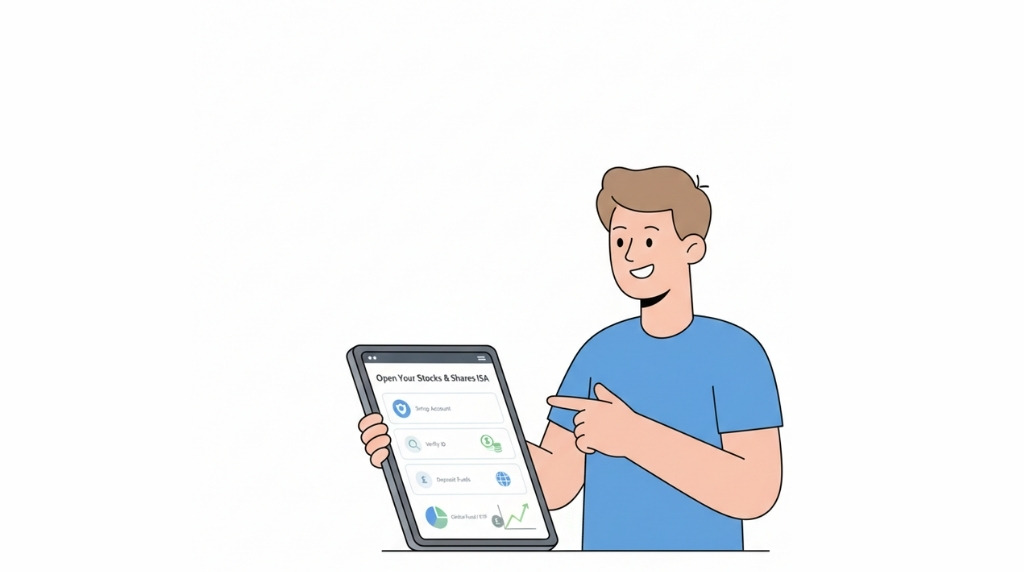
Opening a Stocks and Shares ISA takes less than 10 minutes. Choose an FCA-regulated platform (such as Trading 212, Vanguard, or AJ Bell), complete identity verification, select Stocks and Shares ISA as your account type, deposit money, and choose your investments. You need to be a UK resident aged 18 or over. The annual ISA allowance is 20,000 pounds for the 2025/26 tax year. All gains, dividends, and interest inside the ISA are completely tax-free.
Who Can Open a Stocks and Shares ISA?
To open a Stocks and Shares ISA, you must be a UK resident (or a Crown servant such as a diplomat), be aged 18 or over, and have a valid National Insurance number. There is no upper age limit and no minimum income requirement. You can hold a Stocks and Shares ISA alongside other ISA types (Cash ISA, Lifetime ISA, Innovative Finance ISA) as long as your total contributions across all ISAs do not exceed 20,000 pounds in a single tax year.
Since April 2024, you can also open more than one Stocks and Shares ISA in the same tax year with different providers, though the 20,000 pound total limit still applies. For full details on this rule change, see our guide: Can You Have More Than One Stocks and Shares ISA?
Step 1: Choose a Platform
The first decision is which investment platform to use. Your platform holds your ISA, processes trades, and keeps your investments safe. All major UK platforms offer a Stocks and Shares ISA. The key differences are fees, investment range, and features.
| Platform | Platform Fee | ISA Fee | Dealing Fee | FX Fee | Best For |
| Trading 212 | Zero | Zero | Zero | 0.15% | Low-cost shares and ETFs |
| InvestEngine | Zero | Zero | Zero | N/A | ETF-only portfolios |
| Vanguard | 0.15% | Included | Zero | Included | Vanguard funds |
| AJ Bell | 0.25% | Included | 1.50-5.00 | 0.75% | Wide fund range |
| Hargreaves L. | 0.35% | Included | 6.95 | 1.00% | Research and service |
(Source: Platform websites, February 2026. See our best stocks and shares ISA guide for a full comparison.)
For most beginners, Trading 212 is an excellent choice thanks to zero fees across the board and access to over 12,000 instruments. If you specifically want Vanguard funds (like the LifeStrategy range), the Vanguard platform is the cheapest way to access them. For the widest investment range including bonds and OEICs, Hargreaves Lansdown or AJ Bell are strong options.
Step 2: Sign Up and Verify Your Identity
The application process is fully online on all major platforms and typically takes less than 10 minutes. You will need to provide your full name, date of birth, current address, National Insurance number, a valid email address, and photo ID (passport or driving licence).
FCA regulations require all platforms to verify your identity before allowing you to invest. Most platforms use automated verification, so your account is approved within minutes. In rare cases, manual verification may take one to two business days.
Step 3: Select Stocks and Shares ISA
When creating your account, you will be asked to choose an account type. Select Stocks and Shares ISA. On most platforms, you can also open additional account types (such as a Cash ISA or General Investment Account) alongside your ISA on the same login.
If you already have an ISA with another provider from previous tax years, you do not need to close it before opening a new one. You can open a fresh ISA with a new provider for the current tax year and transfer old ISAs later if you wish. For more on this, see our guide on transferring a Stocks and Shares ISA.
Step 4: Deposit Money
Once your account is verified, deposit funds into your ISA. Most platforms accept bank transfers, debit cards, Apple Pay, and Google Pay. Deposits are typically processed instantly or within a few hours for bank transfers.
There is no mandatory minimum deposit on most platforms (Trading 212, InvestEngine, and Freetrade all allow deposits from 1 pound). Some traditional platforms like Hargreaves Lansdown require a minimum lump sum of 100 pounds or a regular monthly investment of at least 25 pounds.
Step 5: Choose Your Investments
With money in your ISA, you can now buy investments. If you are new to investing, the simplest and most effective approach is to start with a diversified index fund or ETF that tracks a broad market index.
Popular Starter Investments
| Investment | What It Does | Ongoing Charge |
| Vanguard FTSE Global All Cap | Tracks 6,000+ companies worldwide | 0.23% |
| Vanguard FTSE All-World ETF (VWRL) | Tracks 3,700+ companies worldwide | 0.22% |
| Vanguard LifeStrategy 80% | Mix of 80% shares, 20% bonds | 0.22% |
| iShares Core S&P 500 ETF (CSP1) | Tracks 500 largest US companies | 0.07% |
| HSBC FTSE All-World Index | Tracks global developed and emerging | 0.13% |
(Source: Fund factsheets, February 2026. Charges may change. See our full how to start investing UK guide for more starter options.)
You can also buy individual shares (UK or international), investment trusts, and on some platforms, bonds and gilts. For most beginners, a single global tracker fund is the simplest way to get started while maintaining broad diversification.
Step 6: Set Up Regular Contributions (Optional but Recommended)
Setting up a monthly standing order or direct debit into your ISA is one of the most effective investing strategies. Pound cost averaging, where you invest a fixed amount regularly regardless of market conditions, smooths out the impact of volatility and removes the temptation to time the market.
Most platforms allow you to automate this completely. On Trading 212, the Pies feature with AutoInvest deposits your money automatically into your chosen allocation. On Vanguard, you can set up a monthly direct debit from 25 pounds. To see how regular contributions could grow over time, try our investment calculator.
ISA Allowance and Tax Rules
The annual ISA allowance for the 2025/26 tax year (6 April 2025 to 5 April 2026) is 20,000 pounds. This allowance is shared across all ISA types, including Cash ISAs, Lifetime ISAs (up to 4,000 pounds of the total), and Innovative Finance ISAs.
All returns inside your Stocks and Shares ISA are completely tax-free. This includes capital gains from selling investments at a profit, dividends from shares and funds, and interest earned on uninvested cash. You never need to declare ISA returns on a self-assessment tax return.
ISA Rule Changes from April 2027
From 6 April 2027, under-65s will be limited to 12,000 pounds per year in cash ISAs, with at least 8,000 pounds needing to go into stocks and shares or other investment ISAs. Over-65s retain the full 20,000 pound cash ISA allowance. The 2025/26 and 2026/27 tax years are the final years with full flexibility to allocate the entire 20,000 pounds however you choose. For more detail, see our ISA allowance guide.
What Happens After You Open Your ISA?
Once your ISA is open and invested, there are a few things to keep in mind. You can withdraw money at any time without penalty on most platforms (check whether your ISA is flexible before withdrawing and redepositing). Your ISA allowance resets every 6 April. Any unused allowance cannot be carried forward. You can transfer your ISA to a different provider at any time without losing the tax-free status. Always use the official transfer process rather than withdrawing and redepositing, as this would unnecessarily use your current year's allowance.
For long-term investors, the most effective approach is to continue making regular contributions and resist the urge to constantly check or adjust your portfolio. Time in the market consistently outperforms timing the market. For more on building a long-term strategy, see our how to invest money UK guide.
Frequently Asked Questions
Most platforms complete the application and verification process within 10 minutes. You can typically deposit and invest on the same day.
You can open the account with zero balance on most platforms, but you will need to deposit money before you can invest. Many platforms accept deposits from as little as 1 pound.
Yes. You can hold both a Cash ISA and a Stocks and Shares ISA in the same tax year, as long as your total contributions across all ISAs do not exceed 20,000 pounds.
You must be 18 or over to open a Stocks and Shares ISA. For children under 18, a Junior Stocks and Shares ISA (with a 9,000 pound annual allowance) is the appropriate alternative.
Yes, at any time. There is no lock-in period. However, if your ISA is not a flexible ISA, withdrawals will reduce your remaining allowance for the current tax year and cannot be replaced.
No. Opening and managing a Stocks and Shares ISA is straightforward on any major platform and does not require professional advice. If you are unsure what to invest in, a global index fund is a simple starting point. For more guidance, see our how to start investing UK guide.
Yes. You can transfer ISAs from any previous tax year to a new provider at any time. Always use the official transfer process to preserve the tax-free status. See our guide on transferring a Stocks and Shares ISA.
If you leave the UK, you can keep your existing ISA and the investments within it remain tax-free. However, you cannot make new contributions while you are a non-UK resident. You can resume contributions if you return to the UK.
For money you do not need for at least five years, a Stocks and Shares ISA has historically delivered significantly higher returns than a Cash ISA. Over shorter periods, a Cash ISA offers guaranteed returns with no risk of loss. The right choice depends on your timeframe and risk tolerance. See our Cash ISA vs Stocks and Shares ISA guide for a detailed comparison.
For beginners, a single global index fund or ETF provides instant diversification across thousands of companies at low cost. See our guides to the best index funds UK and best ETFs UK for specific recommendations.
Related Reading
Stocks and Shares ISA Explained
Cash ISA vs Stocks and Shares ISA
Trading 212 Stocks and Shares ISA
Capital at risk. The value of your investments can go down as well as up. You may get back less than you invest. Tax treatment depends on your individual circumstances and may change in the future. ISA rules and allowances may also change. If you are unsure whether investing is right for you, seek independent financial advice.