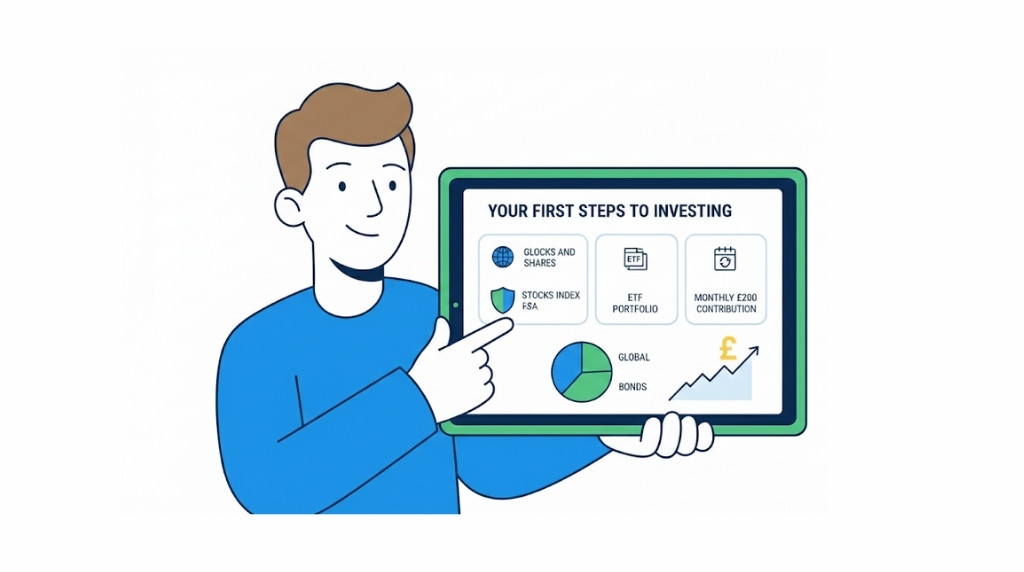
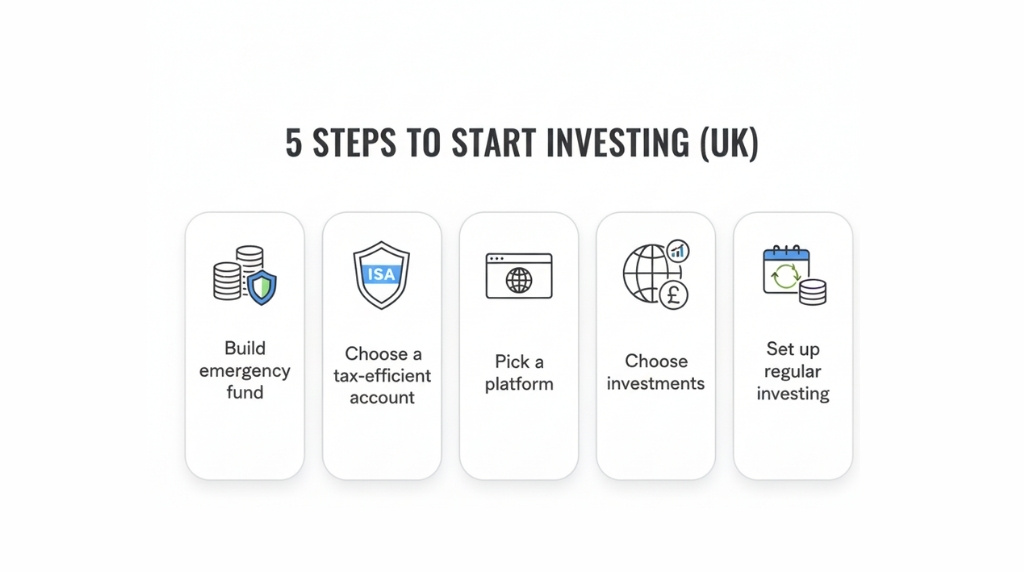
To start investing in the UK, build an emergency fund of three to six months' expenses, open a Stocks and Shares ISA for tax-free investing, choose a low-cost platform like Trading 212 or Vanguard, pick a diversified global index fund or ETF, and set up regular monthly contributions. You can start with as little as 1 pound. The most important step is simply getting started, because time in the market matters far more than timing the market.
Before You Start Investing
Investing is one of the most effective ways to grow your wealth over time, but it is not the first financial step you should take. Before putting money into the stock market, make sure these basics are covered.
1. Clear High-Interest Debt
If you have credit card debt, store cards, or personal loans charging high interest rates, paying these off first will almost always give you a better return than investing. The average UK credit card charges around 23% interest, far above the 8% to 10% long-term average stock market return. Mortgages and student loans are generally low enough interest that you can invest alongside them.
2. Build an Emergency Fund
Set aside three to six months' worth of essential living expenses in an easy-access savings account. This fund is your safety net if you lose your job, face unexpected bills, or have a medical emergency. Without it, a market downturn could force you to sell investments at a loss to cover day-to-day costs.
3. Know Your Goals and Timeframe
Think about what you are investing for and when you will need the money. If your goal is more than five years away (such as retirement, long-term wealth building, or a future house deposit), investing in the stock market makes sense. If you need the money within one to three years, a savings account or Cash ISA is usually more appropriate because short-term market movements could reduce your pot at the wrong time.
Step 1: Choose a Tax-Efficient Account
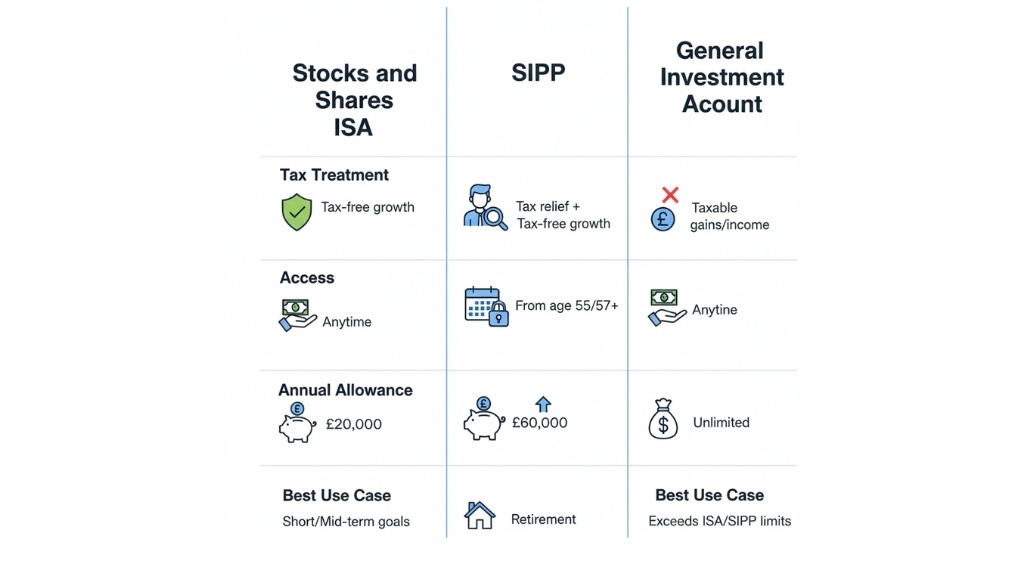
The first decision is where to hold your investments. In the UK, there are two main tax-efficient options for beginners.
Stocks and Shares ISA
A Stocks and Shares ISA lets you invest up to 20,000 pounds per tax year with all gains, dividends, and interest completely tax-free. You never need to declare ISA returns on a tax return. For most beginners, this is the best starting point. The annual ISA allowance is 20,000 pounds for the 2025/26 tax year, shared across all ISA types.
SIPP (Self-Invested Personal Pension)
A SIPP is designed for retirement investing. The government adds tax relief to your contributions (20% for basic rate taxpayers, 40% for higher rate). This means a 100 pound contribution only costs you 80 pounds. The downside is that you cannot access the money until age 57 (rising to 58 from 2028). For a detailed comparison, see our guide on SIPP vs ISA.
General Investment Account (GIA)
If you have already used your ISA allowance, a GIA (sometimes called an Invest account) is the fallback option. Returns in a GIA are subject to capital gains tax and dividend tax, so always use your ISA allowance first.
Our recommendation: Start with a Stocks and Shares ISA. It is the simplest, most flexible tax-efficient account for UK investors. You can withdraw at any time (unlike a SIPP) and all returns are completely tax-free.
Step 2: Pick an Investment Platform
An investment platform (also called a broker) is where you open your ISA and buy your investments. The UK has dozens of platforms, but for beginners the key factors are low fees, a simple interface, and access to a good range of funds and ETFs. Here are the most popular options.
Most Popular UK Investment Platforms
| Platform | Commission | Platform Fee | ISA Fee | Best For | Min Deposit |
|---|---|---|---|---|---|
| Trading 212 | Zero | Zero | Zero | Low-cost ETFs and shares | 1 pound |
| Vanguard | Zero (funds) | 0.15% | Included | Vanguard funds only | 100 pounds |
| InvestEngine | Zero | Zero | Zero | ETF-only portfolios | None |
| AJ Bell | 1.50-5.00 | 0.25% | Included | Widest fund range | None |
| Hargreaves L. | 11.95 | 0.45% | Included | Research and support | None |
(Source: Platform websites, February 2026. Fees may change. See our full guide to the best trading platforms UK for detailed comparisons.)
For most beginners, Trading 212 is an excellent starting point. It charges zero commission, zero platform fees, and zero ISA fees. You can start with as little as 1 pound and buy fractional shares, making it accessible on any budget. If you specifically want Vanguard funds (like the LifeStrategy range), the Vanguard platform charges just 0.15% per year.
Step 3: Decide What to Invest In
This is where many beginners get stuck. The good news is that you do not need to pick individual stocks. In fact, most professional investors recommend that beginners start with diversified funds that spread your money across hundreds or thousands of companies at once.
Index Funds and ETFs (Recommended for Beginners)
An index fund or ETF tracks a broad market index like the FTSE 100, S&P 500, or a global index. Rather than trying to beat the market, it simply matches it. Research consistently shows that low-cost index funds outperform the majority of actively managed funds over the long term, primarily because of their lower fees.
Here are some of the most popular beginner-friendly funds available on major UK platforms.
Popular Funds and ETFs for UK Investors
| Fund | What It Tracks | Ongoing Charge |
|---|---|---|
| Vanguard FTSE Global All Cap Index | 6,000+ companies worldwide | 0.23% |
| Vanguard FTSE All-World UCITS ETF (VWRL) | 3,700+ companies worldwide | 0.22% |
| Vanguard S&P 500 UCITS ETF (VUAG) | 500 largest US companies | 0.07% |
| iShares Core FTSE 100 UCITS ETF | 100 largest UK companies | 0.07% |
| Vanguard LifeStrategy 80% Equity | Global mix (80% shares, 20% bonds) | 0.22% |
(Source: Fund factsheets, February 2026. Charges may change.)
A single global tracker fund like the Vanguard FTSE Global All Cap or the FTSE All-World ETF gives you instant diversification across the world's stock markets. This is arguably the simplest and most effective starting point for a new investor. For US market exposure specifically, see our guide on how to invest in the S&P 500 UK.
Individual Shares
Buying individual shares means owning a small piece of a single company. This can be rewarding but carries more risk than a diversified fund, because your returns depend on the performance of one business. If you want to buy individual shares, consider doing so alongside a core portfolio of index funds rather than putting all your money into a handful of stocks.
Bonds and Gilts
Bonds are loans to governments or companies that pay a fixed interest rate. UK government bonds (gilts) are considered very low risk but offer lower returns than shares over the long term. Beginners who want some bond exposure can use a balanced fund like Vanguard LifeStrategy, which includes a bond allocation automatically.
Other Assets
Other investment options include gold, silver, property funds, and cryptocurrency. These can play a role in a diversified portfolio but are generally not recommended as a sole starting point for beginners.
Step 4: Make Your First Investment
Once you have opened your ISA and deposited money, buying your first investment is straightforward.
Search for the fund or ETF by name or ticker code (for example, VWRL for the Vanguard FTSE All-World ETF). Check the fund's factsheet for its ongoing charge and what it invests in. Enter the amount you want to invest (most platforms allow as little as 1 pound via fractional shares). Confirm the order. Your investment will appear in your portfolio within seconds for ETFs, or one to two business days for OEIC funds.
Step 5: Set Up Regular Investing
One of the most effective investing strategies for beginners is pound cost averaging, where you invest a fixed amount at regular intervals (typically monthly) regardless of what the market is doing. This approach removes the temptation to time the market and smooths out the impact of price fluctuations.
Most platforms let you set up automatic monthly contributions. For example, you might set up a standing order of 100 pounds per month into your ISA, automatically invested into your chosen fund. Over years and decades, this consistent approach tends to produce strong results because you buy more units when prices are low and fewer when prices are high.
To see how regular investing could grow your money over time, try our investment calculator.
How Much Do You Need to Start Investing?
You do not need thousands of pounds. Many UK platforms now allow you to start with as little as 1 pound, thanks to fractional shares. Here is what different starting amounts could look like over time, assuming an average annual return of 7% (after inflation) with monthly contributions.
How Monthly Investing Can Grow Over Time
| Monthly Amount | After 10 Years | After 20 Years | After 30 Years |
|---|---|---|---|
| 25 pounds | 4,300 | 13,000 | 30,400 |
| 50 pounds | 8,600 | 26,100 | 60,800 |
| 100 pounds | 17,300 | 52,100 | 121,600 |
| 250 pounds | 43,200 | 130,300 | 304,000 |
| 500 pounds | 86,400 | 260,600 | 608,100 |
(Illustrative projections only. Assumes 7% average annual return after inflation, compounded monthly. Actual returns will vary. Past performance does not guarantee future results.)
The key takeaway is that even small amounts grow substantially over long periods thanks to compound interest. Starting with 50 pounds per month at age 25 could grow to over 60,000 pounds by age 45 and over 120,000 pounds by age 55. The earlier you start, the more time compounding has to work.
Common Mistakes to Avoid
Trying to Time the Market
Even professional fund managers struggle to consistently predict when markets will rise or fall. Research from Vanguard shows that time in the market almost always beats timing the market. Investing regularly and staying invested through market ups and downs is far more effective than trying to buy at the perfect moment.
Putting All Your Money in One Stock
Concentrating your entire portfolio in a single company is extremely risky. If that company fails, you lose everything. A diversified index fund spreads your risk across hundreds or thousands of companies.
Checking Your Portfolio Too Often
Markets move up and down daily. Checking your portfolio every day can create anxiety and tempt you to make impulsive decisions. For long-term investors, checking once a month or once a quarter is usually sufficient.
Investing Money You Cannot Afford to Lose
Never invest money you will need in the next one to three years, or money earmarked for essential expenses. Investing is for money you can leave untouched for at least five years, ideally longer.
Ignoring Fees
Even small differences in fees compound significantly over time. A fund charging 1.5% per year will cost you tens of thousands of pounds more than a fund charging 0.2% over a 30-year investment period. Always check the ongoing charge figure (OCF) before investing.
Understanding Investment Risk
All investing carries risk. The value of your investments can go down as well as up, and you may get back less than you put in. However, understanding the types of risk can help you manage them.
Market risk is the chance that the overall stock market falls. This affects all investors, but historically markets have always recovered from downturns over the long term. The FTSE 100 has survived the 2008 financial crisis, the 2020 pandemic crash, and multiple recessions, and reached new all-time highs.
Inflation risk is the chance that your returns do not keep pace with rising prices. Cash savings are particularly vulnerable to this. Over the past century, UK equities have significantly outperformed both cash and bonds in real (inflation-adjusted) terms.
Currency risk applies when you invest in assets denominated in foreign currencies. Exchange rate movements can affect your returns. Global funds naturally carry some currency risk, but this tends to balance out over long periods.
Concentration risk is the danger of holding too few investments. Diversification through broad index funds is the simplest way to reduce this risk.
Frequently Asked Questions
You can start with as little as 1 pound on platforms like Trading 212 that support fractional shares. There is no meaningful minimum to begin building a portfolio.
For most UK investors, yes. A Stocks and Shares ISA provides tax-free growth, tax-free dividends, and tax-free withdrawals with no time lock. It should be your first port of call before using a GIA or SIPP.
A single global index fund or ETF, such as the Vanguard FTSE Global All Cap or FTSE All-World ETF (VWRL), gives you instant diversification across thousands of companies worldwide at a very low cost. See our list of the best index funds UK for more options.
At least five years, ideally ten years or more. The longer your time horizon, the greater the chance of positive returns and the more time compound interest has to work in your favour. Investing is a long-term strategy, not a way to make quick money.
With a diversified index fund, losing all your money is extremely unlikely because it would require every company in the index to fail simultaneously. However, your portfolio can temporarily lose value during market downturns. This is normal and is why investing is best suited for money you will not need in the short term.
Research suggests that lump sum investing slightly outperforms monthly investing about two-thirds of the time, because markets tend to rise over the long term. However, monthly investing (pound cost averaging) reduces the risk of investing at a market peak and is psychologically easier for most beginners. See our investing strategies guide for more detail.
A share is a piece of one company. A fund is a collection of many shares (and sometimes bonds) bundled together. Buying a fund gives you instant diversification, while buying individual shares means your returns depend on the performance of a single company.
No. All returns inside a Stocks and Shares ISA are completely tax-free, including capital gains, dividends, and interest. You do not need to declare ISA returns on your tax return. Outside an ISA, you would pay capital gains tax and dividend tax.
For low-cost, simple investing, Trading 212 and InvestEngine are strong choices with zero fees. For Vanguard-only investors, the Vanguard platform is excellent. For the widest range of research and support, Hargreaves Lansdown is a good option. See our full best trading platforms UK guide.
No. The best time to start investing was 20 years ago. The second best time is today. Even starting in your 40s, 50s, or beyond can make a meaningful difference to your financial future. The key is to start with an amount you are comfortable with and invest consistently.
Related Reading
How to Invest in the S&P 500 UK
Capital at risk. The value of your investments can go down as well as up. You may get back less than you invest. Tax treatment depends on your individual circumstances and may change in the future. ISA rules and allowances may also change. If you are unsure whether investing is right for you, seek independent financial advice.