Yes, investing has historically been worth it for anyone with a time horizon of five years or more. UK equities have beaten cash nine times out of ten over any rolling 10-year period since 1899. Someone investing £1,000 per year since 1999 would have roughly £92,000 in global stocks compared to £36,000 in a Cash ISA. However, investing comes with risk, and it is not suitable for money you need in the short term. The key factor that determines whether investing is worth it for you is time.
It is a question millions of people ask themselves every year: is investing actually worth it? With Cash ISA rates above 4% and the stock market prone to sharp falls, it can feel safer to leave your money in a savings account and avoid the uncertainty altogether.
According to the FCA's Financial Lives Survey 2024, only 35% of UK adults hold investments. A striking 61% of those with more than £10,000 in assets keep most of it in cash. The UK has the lowest retail investment participation rate in Europe, with British retail investors controlling just 21% of assets under management, compared to 84% in Spain, 34% in Italy and 30% in Germany.
So is the majority right to stay in cash, or are they quietly losing money to inflation? This guide looks at what the data actually shows, how investing compares to saving, and how to decide whether investing is right for your situation. For a direct comparison of the two main tax-free options, see our Cash ISA vs Stocks and Shares ISA guide.
What Does the Long-Term Data Say About Investing vs Cash?
The Barclays Equity Gilt Study
The single most important piece of evidence in this debate comes from the Barclays Equity Gilt Study, which has tracked UK investment returns since 1899. Over the past 130 years, the study found that UK equities outperformed cash in nine out of every ten rolling 10-year periods. Over 20-year periods, stocks have beaten cash virtually every time.
In more recent data, stocks returned approximately 3.1% per year above inflation over the past 20 years. Cash, by contrast, lost around 1.8% per year in real terms over the same period (source: Barclays Equity Gilt Study 2024, cited by AJ Bell).
AJ Bell analysis: £1,000 per year since 1999
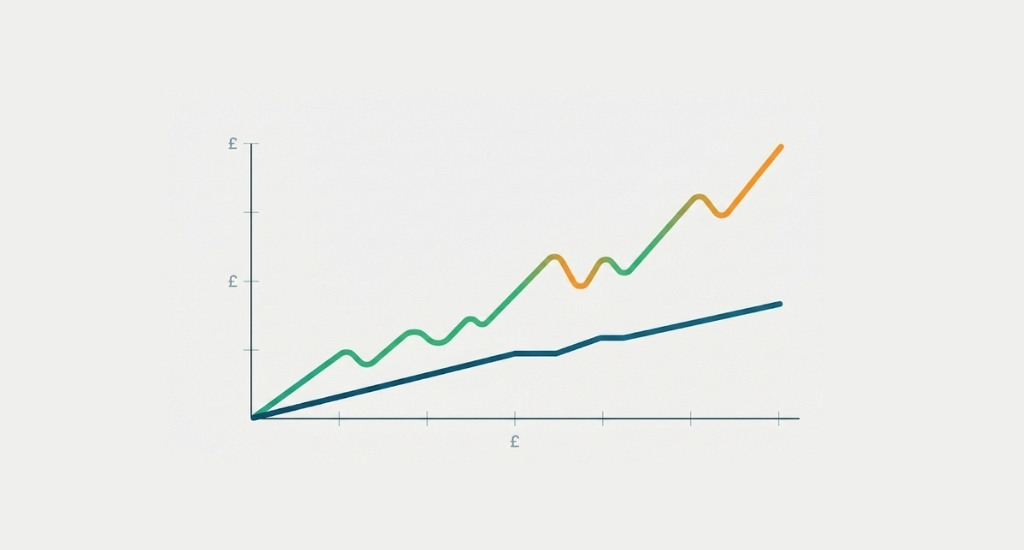
AJ Bell analysis puts hard numbers on the gap. Someone who invested £1,000 per year into the average UK stock fund since ISAs launched in April 1999 would have accumulated roughly £67,866 by September 2025. The same contributions into a Cash ISA would have grown to just £36,290, barely more than the £26,000 actually deposited. In global stock funds, that figure reaches approximately £92,349, and in North American funds, roughly £127,887.
Growth comparison table
| Where £1,000/year went | Value after 26 years | Gain above contributions |
| Cash ISA (average) | £36,290 | +£10,290 (40%) |
| UK stocks (UK All Cos) | £67,866 | +£41,866 (161%) |
| Global stocks (IA Global) | £92,349 | +£66,349 (255%) |
| North America stocks | £127,887 | +£101,887 (392%) |
Source: AJ Bell/Bank of England/FE. Data from 30 April 1999 to September 2025. Investment figures show average sector performance including fund charges. Cash ISA returns based on average interest rate available.
Lump sum comparison
Even a one-off £1,000 lump sum invested in April 1999 tells the same story. In a Cash ISA, it would be worth approximately £2,079 by the end of 2025. In the average UK stock fund, approximately £3,787. In a North American fund, roughly £6,285 (source: AJ Bell).
Why Keeping All Your Money in Cash Can Cost You
The invisible cost of inflation
The biggest risk of not investing is not a dramatic loss. It is the slow, invisible erosion of your purchasing power through inflation.
UK households currently hold approximately £1.7 trillion in cash deposits. At an average inflation rate of 3.5% (the 25-year UK average), that equates to roughly £60 billion in lost purchasing power every single year. Over 25 years, cash savings can lose around 58% of their real value.
To put that in personal terms: £1 saved in cash in 1975 now has the purchasing power of just 7p. That is a 93% loss to inflation over 50 years, according to ONS data.
Current rates vs inflation in 2026
In January 2026, UK CPI inflation stood at 3%, according to the Office for National Statistics. If your savings account or Cash ISA pays 4%, your real return is around 1% per year. That is better than losing money, but it is a long way from building wealth.
Stocks, on the other hand, have historically delivered real (inflation-adjusted) returns of around 5% to 7% per year over the long term. Company earnings and dividends tend to grow broadly in line with or faster than inflation, which is why equities have been the most reliable way to build purchasing power over periods of a decade or more.
What Investing £50, £200 or £500 Per Month Could Be Worth
You do not need thousands to start
One of the biggest misconceptions about investing is that you need thousands of pounds to get started. According to the Investment Association, only 22% of UK adults realise you can begin investing with less than £50. In reality, many platforms let you start with as little as £1. Our how much to start investing guide covers the minimum amounts for every major platform.
The Investment Association calculated that investing just £50 per month into a typical global equity fund over the past five years would have been worth £3,906 by the end of 2025, more than £900 ahead of the same money held in cash savings. That gap compounds significantly over longer periods.
Projected growth over 10, 20 and 30 years
The table below shows what a regular monthly investment could potentially grow to, assuming a 7% average annual return (roughly in line with long-term global equity averages) compared to 3% in a cash savings account. These are illustrative projections, not guarantees.
| Monthly | 10yr cash | 10yr invest | 20yr cash | 20yr invest | 30yr cash | 30yr invest |
| £50/mo | £6,990 | £8,600 | £16,390 | £26,000 | £29,100 | £60,700 |
| £200/mo | £27,960 | £34,400 | £65,560 | £104,000 | £116,400 | £242,800 |
| £500/mo | £69,900 | £86,000 | £163,900 | £260,000 | £291,000 | £607,000 |
Illustrative projections only. Assumes 7% annual return (investing) and 3% annual return (cash). Does not account for fees, tax or inflation. Actual returns will vary. Past performance is not a reliable indicator of future results.
The power of compounding
The difference between cash and investing grows dramatically over time thanks to compound growth. At £200 per month over 30 years, the gap is more than £126,000. That is the real cost of not investing for someone who has the time and risk tolerance to do so. Use our Stocks and Shares ISA calculator to model your own projections.
What Are the Risks of Investing?
Investing is not guaranteed to make you money. It is important to be honest about the risks before committing any money you cannot afford to lose.
Your investments can fall in value
Stock markets can drop sharply, sometimes by 30% or more in a single year. The Covid-19 crash in March 2020 saw global markets lose a third of their value in a matter of weeks. The average Stocks and Shares ISA fund lost 3.27% between February 2022 and February 2023, according to Moneyfacts. However, markets have recovered from every major crash in history, which is why time in the market matters more than timing the market.
Short-term volatility is normal
Even in good years, markets fluctuate daily. Seeing your portfolio drop by 5% or 10% in a single month is not unusual and does not mean you have made a bad decision. The challenge is psychological: panic selling during a downturn locks in losses and is the single biggest mistake retail investors make.
You can pick the wrong investments
Individual stocks can and do go to zero. Companies fail, sectors decline and trends reverse. This is why diversification (spreading your money across many investments) is so critical. A global index fund holding thousands of companies eliminates the risk of any single company destroying your portfolio.
Fees can eat into returns
Platform charges, fund management fees and dealing costs all reduce your returns. Choosing low-cost platforms and index funds can make a significant difference. A fund with a 0.12% ongoing charge (like the Fidelity Index World) will cost you far less over 20 years than an actively managed fund charging 1% or more.
When Is Investing Not Worth It?
Investing is not always the right choice. There are specific situations where keeping your money in cash makes more sense.
You need the money within three years
If you need the money within the next one to three years, investing is too risky. Markets can fall at any time, and a short time horizon does not give your investments enough time to recover from a downturn.
You do not have an emergency fund
If you do not have an emergency fund covering three to six months of essential expenses, building that safety net in a Cash ISA or easy access savings account should come first. Investing money you might need at short notice means you could be forced to sell at a loss.
You have high-interest debt
If you have high-interest debt, particularly credit cards charging 20% or more, paying that off will give you a guaranteed, risk-free return far higher than any investment is likely to deliver.
You cannot handle seeing your portfolio drop
If the idea of your portfolio dropping 20% would cause you serious distress or lead you to sell in a panic, you may need to start with a smaller amount or a lower-risk portfolio until you build confidence and experience.
When Is Investing Worth It?
The data overwhelmingly shows that investing is worth it when two conditions are met: you have a time horizon of at least five years, and you can tolerate short-term losses without panic selling.
Ideal situations for investing
Investing is particularly worthwhile if you are saving for retirement (whether through a SIPP, workplace pension or Stocks and Shares ISA), building long-term wealth for a house deposit that is several years away, or growing a pot of money that you do not have immediate plans for.
The cost of waiting
The earlier you start, the more powerful compounding becomes. An investor who starts at 25 and invests £200 per month at 7% average annual returns would accumulate approximately £607,000 by age 55. Someone who waits until 35 to start the same contributions would accumulate roughly £260,000 by 55. That 10-year head start is worth an additional £347,000, despite only contributing an extra £24,000.
How to Start Investing in the UK in 2026
If you have decided that investing is right for you, getting started is simpler than most people expect. Our full how to start investing UK guide walks through each step in detail. Here is a summary.
Step 1: Build an emergency fund first
Set aside three to six months of essential expenses in a Cash ISA or easy access savings account. This ensures you will never be forced to sell investments to cover an unexpected bill.
Step 2: Open a Stocks and Shares ISA
A Stocks and Shares ISA protects your investment returns from income tax, capital gains tax and dividend tax. You can invest up to £20,000 per tax year. Popular platforms include Trading 212 (no platform fee, commission-free), Vanguard (0.15% fee, capped at £375/year), AJ Bell (0.25% fee) and InvestEngine (0% fee for its own portfolios).
Step 3: Choose a simple, diversified investment
If you are new to investing, a global index fund is one of the simplest and most effective options. Funds like the Vanguard FTSE Global All Cap Index (0.23% ongoing charge) or the Fidelity Index World (0.12% ongoing charge) spread your money across thousands of companies worldwide. Our guide to the best ETFs UK also covers great options.
Step 4: Set up a regular monthly contribution
Investing a fixed amount each month (sometimes called pound-cost averaging) smooths out the impact of market volatility. When prices are low, your money buys more units. When prices are high, it buys fewer. Over time, this tends to produce a lower average cost than trying to time the market. Our investing strategies for beginners guide explains this and other approaches.
Step 5: Leave it alone
The most successful investors are those who invest consistently and resist the urge to check their portfolio daily or react to short-term news. Set a reminder to review your investments once or twice a year, and otherwise let compounding do the work.
Frequently Asked Questions
Is investing worth it with just £50 per month?
Yes. Even small amounts add up significantly over time thanks to compounding. The Investment Association found that £50 per month invested in a global equity fund over five years would have been worth over £900 more than the same money held in cash. Over 20 or 30 years, the difference becomes transformative.
Is investing better than saving in a Cash ISA?
Over periods of five years or more, investing has historically delivered significantly higher returns than cash. Over shorter periods, cash is more predictable and carries no risk of capital loss. Most financial experts recommend using both: cash for short-term needs and investments for long-term growth. See our Cash ISA vs Stocks and Shares ISA comparison for the full breakdown.
Can I lose all my money investing?
If you invest in a single company that fails, yes. If you invest in a diversified index fund holding thousands of companies, the chance of losing everything is effectively zero. Global stock markets have recovered from every crash in history, including world wars, financial crises and pandemics.
What is the average return from a Stocks and Shares ISA?
According to Moneyfacts, the average Stocks and Shares ISA fund has returned approximately 6.19% per year over the past five years. Over the past decade, some sources cite average returns closer to 9.6%. Individual returns vary significantly depending on what you invest in and when.
Do I need to pay tax on investment profits?
Not if you invest through a Stocks and Shares ISA. All returns, including capital gains, dividends and interest, are completely tax-free within an ISA. Outside an ISA, you would pay capital gains tax on shares above the £3,000 annual exemption and dividend tax on dividends above the £500 annual allowance.
When should I start investing?
As soon as you have an emergency fund in place and no high-interest debt. The earlier you start, the more time compounding has to work. A 10-year head start can be worth hundreds of thousands of pounds over a lifetime of investing.
Related Reading
• Cash ISA vs Stocks and Shares ISA
• Best Stocks and Shares ISA 2026
• How to Invest in Index Funds UK
• Investing Strategies for Beginners
• SIPP vs ISA: Which Is Better?