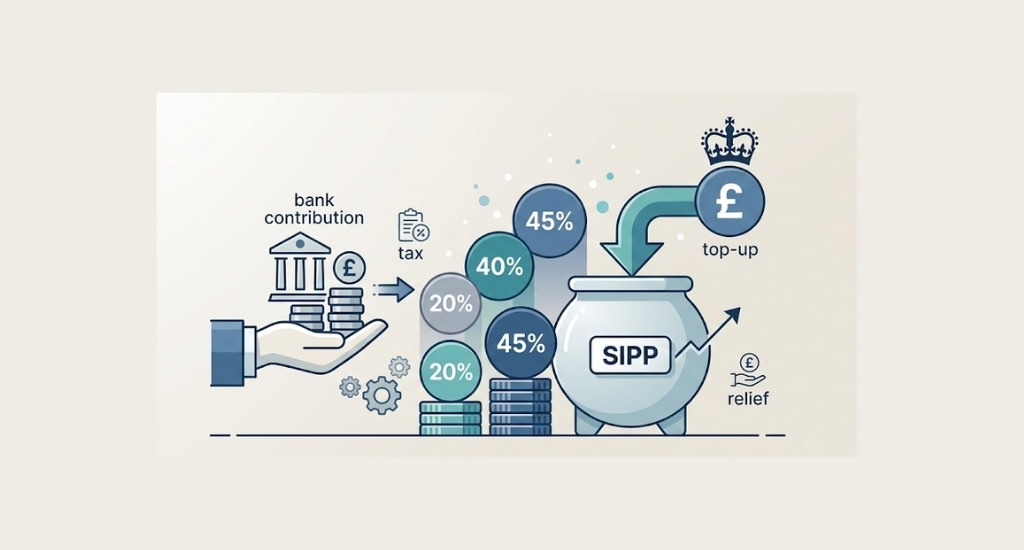
When you contribute to a SIPP, the government automatically adds 20% tax relief. For every £80 you pay in, your pension receives £100. Higher rate (40%) and additional rate (45%) taxpayers can claim a further 20% or 25% back through Self Assessment. The annual allowance for 2025/26 is £60,000 (or 100% of your earnings, whichever is lower). You can carry forward unused allowance from the previous three tax years. Even non-earners can contribute up to £2,880 per year, which is topped up to £3,600.
Tax relief is one of the most powerful benefits of saving into a SIPP (Self-Invested Personal Pension). It effectively means the government gives you back some or all of the income tax you have paid on money you choose to put towards your retirement.
Despite this, many people either do not fully understand how SIPP tax relief works, or fail to claim the full amount they are entitled to. Higher rate and additional rate taxpayers, in particular, frequently leave money on the table by not claiming the extra relief available through Self Assessment.
This guide explains exactly how SIPP tax relief works in the 2025/26 tax year, how much you can contribute, and how to make sure you claim every penny you are owed.
How Does SIPP Tax Relief Work?
When you contribute to a SIPP, your provider uses a system called relief at source. This means you make contributions from your after-tax income (the money in your bank account), and your SIPP provider automatically claims the basic rate tax relief (20%) from HMRC and adds it to your pension pot.
Basic rate taxpayers (20%)
For every £80 you contribute, your provider claims £20 from HMRC, bringing the total contribution in your pension to £100. This happens automatically. You do not need to do anything to claim it. It typically takes six to eleven weeks for HMRC to process the tax reclaim.
Higher rate taxpayers (40%)
You receive the same automatic 20% top-up as basic rate taxpayers. However, you are entitled to claim an additional 20% back through your Self Assessment tax return. This extra relief comes as a reduction in your tax bill or a tax refund, rather than being added directly to your pension.
For example, if you contribute £800 net to your SIPP, your provider claims £200 (20% relief), bringing your pension pot to £1,000. You then claim a further £200 (the extra 20%) through Self Assessment. Your net cost for a £1,000 pension contribution is £600.
Additional rate taxpayers (45%)
The same principle applies, but you can claim a further 25% through Self Assessment (the difference between 45% and 20%). For a £1,000 gross pension contribution, your net cost is just £550.
Scottish taxpayers
If you are a Scottish taxpayer, your SIPP provider still claims the first 20% automatically. You must claim the remaining difference through Self Assessment. Scottish income tax rates differ from the rest of the UK, with intermediate (21%), higher (42%) and top (47%) bands, so the additional relief amount varies depending on your rate.
How Much SIPP Tax Relief Do You Get at Each Tax Rate?
The table below shows the cost of a £1,000 gross pension contribution at each income tax band for the 2025/26 tax year.
| Tax band | Rate | You pay | Auto relief | Extra claim |
| Non-taxpayer | 0% | £800 | £200 | None |
| Basic rate | 20% | £800 | £200 | None |
| Higher rate | 40% | £800 | £200 | £200 via SA |
| Additional rate | 45% | £800 | £200 | £250 via SA |
SA = Self Assessment tax return. Figures based on a £1,000 gross pension contribution in the 2025/26 tax year. Net cost to the taxpayer: basic rate £800, higher rate £600, additional rate £550. Source: HMRC.
Even non-taxpayers benefit from SIPP tax relief. If you earn below the £12,570 personal allowance, or have no earnings at all, you can still contribute up to £2,880 per year to a SIPP and receive £720 in tax relief, bringing the total to £3,600. This applies to stay-at-home parents, retirees and anyone else not currently paying income tax.
What Is the SIPP Annual Allowance?
The annual allowance is the maximum amount that can be contributed to your pensions in a single tax year before you face a tax charge. For 2025/26, the annual allowance is £60,000, or 100% of your UK earnings, whichever is lower. This limit includes all pension contributions: your personal contributions, employer contributions, and any tax relief added.
Tapered annual allowance for high earners
If your adjusted income exceeds £260,000, your annual allowance is reduced by £1 for every £2 of income above this threshold. The minimum annual allowance after tapering is £10,000, which applies once adjusted income reaches £360,000. The taper only applies if your threshold income (broadly your net income before pension contributions) is above £200,000.
Money purchase annual allowance (MPAA)
If you have already started accessing your pension flexibly (for example, by taking income through drawdown), your annual allowance for future money purchase contributions drops permanently to £10,000. Taking a tax-free lump sum alone does not trigger the MPAA, but any flexible income withdrawal does.
Carry forward: using unused allowance from previous years
If you did not use your full £60,000 allowance in any of the previous three tax years, you can carry the unused amount forward. This means you could potentially contribute significantly more than £60,000 in a single year, subject to having sufficient earnings.
To use carry forward, you must have been a member of a registered pension scheme in each year you are carrying forward from, and you must use the current year's full allowance first before dipping into previous years. The oldest unused allowance is used first.
Carry forward example
Suppose you contributed £15,000 in 2022/23 (allowance £40,000), £20,000 in 2023/24 (allowance £60,000) and £10,000 in 2024/25 (allowance £60,000). Your unused allowance carried forward would be £25,000 + £40,000 + £50,000 = £115,000. In 2025/26, you could contribute up to £175,000 (£60,000 current year + £115,000 carried forward), provided your earnings support it.
How to Claim SIPP Tax Relief
Basic rate relief (automatic)
You do not need to do anything. Your SIPP provider handles this for you. When you contribute to your SIPP, the provider claims 20% tax relief from HMRC and adds it to your pension pot. This typically takes six to eleven weeks to arrive.
Higher and additional rate relief (Self Assessment)
If you pay tax at 40% or 45%, you must claim the additional relief yourself. You do this through your annual Self Assessment tax return, in the section for pension contributions. You will need to enter the gross amount of your pension contributions (the amount you paid in plus the basic rate relief already added).
If you do not normally file a Self Assessment return, you can write to HMRC or call them to request an adjustment to your tax code, which will give you the extra relief through your PAYE salary. Alternatively, you can register for Self Assessment specifically to claim pension tax relief.
Salary sacrifice (an alternative method)
Some workplace pensions use salary sacrifice instead of relief at source. Under salary sacrifice, your employer reduces your gross salary and pays the sacrificed amount directly into your pension. Because your gross salary is lower, you pay less income tax and less National Insurance. Your employer also saves on employer NI contributions (currently 13.8%).
Salary sacrifice gives you the full tax relief at your marginal rate automatically through payroll, without needing to file a Self Assessment return. It also saves you National Insurance, which relief at source does not. However, it reduces your official gross salary, which could affect mortgage applications, statutory benefits and other salary-linked entitlements.
What Other Tax Benefits Does a SIPP Offer?
Tax-free investment growth
Investments held inside a SIPP grow free from both income tax and capital gains tax. Dividends are not subject to dividend tax, and there is no CGT when you sell investments within the SIPP. This compounding advantage can make a significant difference over decades of investing.
25% tax-free lump sum at retirement
When you reach retirement age (currently 55, rising to 57 from April 2028), you can take up to 25% of your pension pot as a tax-free lump sum. The maximum tax-free lump sum is capped at £268,275 for the 2025/26 tax year. Any income you draw beyond the 25% lump sum is taxed as ordinary income at your marginal rate.
Inheritance tax advantages
SIPPs generally sit outside your estate for inheritance tax purposes. If you die before 75, your beneficiaries can inherit the pension completely tax-free. If you die after 75, they will pay income tax at their marginal rate when they draw from the inherited pension, but no inheritance tax applies to the pension itself.
How Does SIPP Tax Relief Compare to ISA Tax Benefits?
Both SIPPs and Stocks and Shares ISAs offer tax-free investment growth. However, there are key differences in how contributions and withdrawals are taxed. Our full SIPP vs ISA comparison covers this in detail.
| Feature | SIPP | Stocks and Shares ISA |
| Tax relief on contributions | Yes (20% to 45%) | No |
| Tax-free growth | Yes | Yes |
| Tax on withdrawals | 75% taxed as income | Completely tax-free |
| Annual allowance | £60,000 | £20,000 |
| Access | Age 55 (57 from 2028) | Any time |
| Inheritance tax | Usually outside estate | Part of estate |
For most people, the optimal strategy is to use both. Contribute to a SIPP to benefit from tax relief on the way in, and use a Stocks and Shares ISA for tax-free flexibility and access before retirement age.
The 60% Tax Trap: Why Earning Between £100,000 and £125,140 Makes SIPP Contributions Especially Valuable
If you earn between £100,000 and £125,140, you lose £1 of your £12,570 personal allowance for every £2 you earn above £100,000. This creates an effective marginal tax rate of 60% in this income band.
Making SIPP contributions can reduce your adjusted net income below £100,000, restoring some or all of your personal allowance. This means every £1 you contribute effectively saves you 60p in tax, making SIPP contributions exceptionally tax-efficient in this income range.
For example, if you earn £110,000, contributing £10,000 to your SIPP would reduce your adjusted net income to £100,000, restoring £5,000 of personal allowance. The tax saving on the contribution plus the restored allowance can amount to an effective relief rate of 60%.
Common SIPP Tax Relief Mistakes to Avoid
Not claiming higher or additional rate relief
The most common mistake is failing to claim the extra tax relief through Self Assessment. Your SIPP provider only claims 20% automatically. If you pay 40% or 45% tax, you must actively claim the rest. HMRC does not chase you for this.
Exceeding the annual allowance
If total pension contributions (yours, your employer's, and tax relief) exceed £60,000 in a tax year, you will face an annual allowance charge. The excess is added to your taxable income and taxed at your marginal rate. Always check your total contributions across all pension schemes.
Forgetting carry forward
Many people do not realise they can carry forward unused allowance from previous years. If you have had low contribution years recently, you may be able to make a much larger contribution this year.
Triggering the MPAA accidentally
If you access your pension flexibly (taking taxable income from it), your future annual allowance drops permanently to £10,000. Taking only a tax-free lump sum does not trigger this, but any flexible income withdrawal does. Be aware of this before making any pension withdrawals.
Frequently Asked Questions
How much SIPP tax relief can I get?
For the 2025/26 tax year, the annual allowance is £60,000 (or 100% of your earnings, whichever is lower). Basic rate taxpayers get 20% relief automatically. Higher rate taxpayers can claim up to 40%, and additional rate taxpayers up to 45%. Non-earners can contribute up to £2,880 and receive £720 in relief, bringing the total to £3,600.
Do I get tax relief automatically on my SIPP?
Basic rate relief (20%) is added automatically by your SIPP provider. If you pay tax at 40% or 45%, you must claim the additional relief yourself through Self Assessment or by contacting HMRC.
Can I contribute to a SIPP if I am self-employed?
Yes. Self-employed individuals can contribute to a SIPP and receive exactly the same tax relief as employees. The provider adds 20% relief automatically, and you claim any additional relief through your Self Assessment tax return, which you already file as a self-employed person.
What happens if I contribute more than the annual allowance?
You will face an annual allowance charge. The amount exceeding the allowance is added to your taxable income and taxed at your marginal rate. You can report and pay this charge through Self Assessment.
Can I contribute to a SIPP for my spouse or child?
Yes. You can contribute to a SIPP on behalf of your spouse, civil partner or child. The contribution counts towards the recipient's annual allowance, and they receive basic rate relief even if they are a non-taxpayer (up to £2,880 net per year, topped up to £3,600). For children, a Junior SIPP can be opened from birth.
When can I access my SIPP?
You can access your SIPP from age 55 (rising to 57 from April 2028). You can take up to 25% as a tax-free lump sum (capped at £268,275 for 2025/26). The remaining 75% is taxed as income when you withdraw it. Our SIPP vs personal pension guide explains the withdrawal options in more detail.
Is a SIPP better than a workplace pension?
Not necessarily. If your employer matches your contributions, always contribute enough to get the full employer match first, as this is free money. A SIPP is best used alongside a workplace pension for additional contributions, or if you want more control over your investments. Our SIPP vs ISA guide compares the two main tax-efficient wrappers.
Related Reading
• SIPP vs ISA: Which Is Better?
• Best Stocks and Shares ISA 2026
• Capital Gains Tax on Shares UK