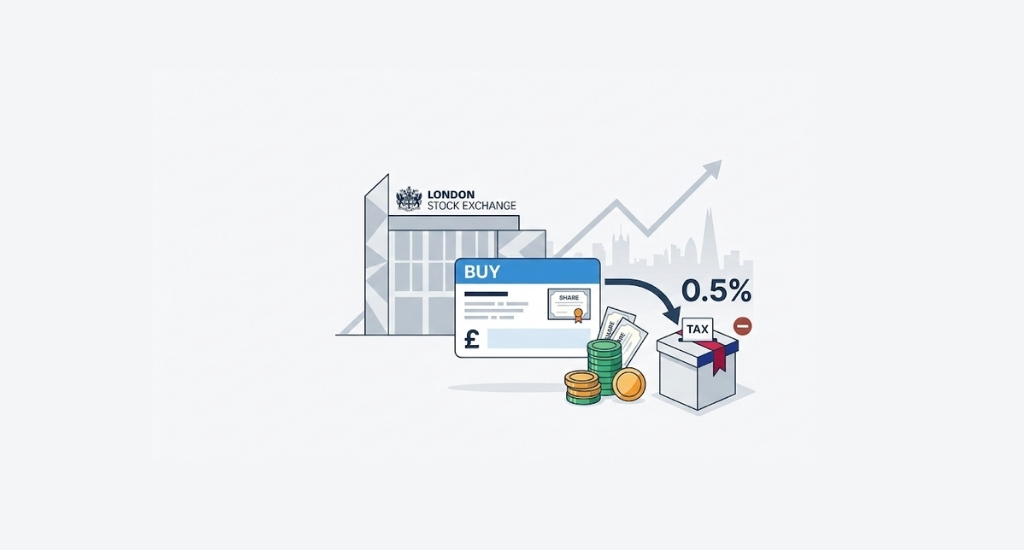
When you buy shares in a UK company, you pay stamp duty or Stamp Duty Reserve Tax (SDRT) at a rate of 0.5% of the purchase price. If you buy £10,000 worth of shares, you pay £50 in tax. This applies whether you hold the shares in a general investment account, a Stocks and Shares ISA or a SIPP. The tax is collected automatically by your broker for electronic purchases. Shares traded on AIM are exempt. The government has also introduced a new three-year SDRT exemption for newly listed companies from November 2025, and plans to replace the entire stamp duty on shares framework with a single new tax from 2027.
Stamp duty on shares is one of those costs that many investors overlook. Unlike capital gains tax or dividend tax, which only apply when you sell or receive income, stamp duty is charged every time you buy UK shares. It is deducted automatically by your broker, so you may not even notice it.
Understanding how this tax works can help you make more informed decisions about your investments, particularly when it comes to choosing between UK and international shares, or deciding whether to invest in individual stocks or funds.
This guide explains the current rules, rates, exemptions and upcoming changes for the 2025/26 tax year. If you are new to buying shares, our how to buy shares UK guide covers the basics step by step.
What Is Stamp Duty on Shares?
Stamp duty on shares is a UK tax charged on the purchase of shares in companies incorporated in the UK. There are actually two closely related taxes that cover share transactions, and which one applies depends on how the shares are transferred.
Stamp Duty Reserve Tax (SDRT)
SDRT applies to electronic share purchases made through the CREST settlement system, which is how virtually all retail share transactions are processed in the UK. If you buy shares through a broker or trading platform, SDRT is what you pay. It is charged at 0.5% of the purchase price and is collected automatically by your broker during settlement. You do not need to do anything to pay it. There is no minimum threshold for SDRT, so it applies to purchases of any value.
Stamp duty (paper transfers)
Traditional stamp duty applies to paper-based share transfers using a stock transfer form (known as a J30 form). This is more common in private company transactions rather than publicly traded shares. Stamp duty is also charged at 0.5% but is rounded up to the nearest £5. It only applies to transfers where the consideration exceeds £1,000. The buyer must pay the stamp duty to HMRC and have the transfer form stamped before the new ownership can be registered.
Which one applies to most investors?
If you are buying shares through an online broker or trading app, SDRT is what applies to you. Your broker handles the payment automatically, and the 0.5% charge is included in your transaction costs. You will see it deducted as part of the settlement process, typically shown as a line item on your contract note.
What Are the Current Stamp Duty Rates on Shares?
| Transaction type | Rate | Threshold | How paid |
| Electronic purchase (SDRT) | 0.5% | No minimum | Automatic via broker |
| Paper transfer (stamp duty) | 0.5% | Over £1,000 | Paid to HMRC |
| Transfer to depositary/clearance | 1.5% | No minimum | Paid to HMRC |
| AIM shares | 0% | N/A | N/A |
| Newly listed shares (from Nov 2025) | 0% for 3 years | N/A | N/A |
Source: HMRC, GOV.UK. The 1.5% rate applies to transfers into depositary receipt schemes or clearance services (not relevant to most retail investors). Rates correct as of March 2026.
How Much Does Stamp Duty on Shares Actually Cost You?
At 0.5%, stamp duty on shares may not seem significant on individual transactions, but it adds up over time, particularly for active traders or investors making regular purchases.
Example calculations
| Purchase amount | SDRT at 0.5% | Total cost to investor |
| £1,000 | £5.00 | £1,005.00 |
| £5,000 | £25.00 | £5,025.00 |
| £10,000 | £50.00 | £10,050.00 |
| £20,000 (full ISA allowance) | £100.00 | £20,100.00 |
If you invest £20,000 per year in UK shares (the full ISA allowance) you would pay £100 per year in SDRT. Over 20 years, that amounts to £2,000 in stamp duty alone, before accounting for the opportunity cost of that money not being invested.
For context, this is in addition to any platform fees, dealing charges and fund management fees. Our best trading platforms UK guide compares the overall costs of each platform.
What Shares Are Exempt From Stamp Duty?
Not all share purchases attract stamp duty or SDRT. Several important exemptions exist.
AIM shares
Shares listed on the Alternative Investment Market (AIM) are exempt from stamp duty and SDRT. This exemption has been in place since 2014 and was introduced to support smaller, growing companies. AIM includes over 700 companies, many of which are in early-stage growth sectors. However, from April 2026, the inheritance tax benefits of AIM shares are being reduced under changes announced in the Autumn Budget 2024, with business property relief dropping from 100% to 50% for AIM holdings.
Newly listed companies (UK Listing Relief)
The government introduced a new SDRT exemption in the Autumn Budget 2025, effective from 27 November 2025. Shares in companies that are newly listed on a UK regulated market (such as the London Stock Exchange main market) are exempt from the 0.5% SDRT charge for the first three years following their listing. This measure is designed to boost liquidity in newly listed stocks and attract more companies to list in the UK.
The exemption covers all of the company's securities, not just ordinary shares, and also applies to depositary interests. However, it does not apply to the 1.5% SDRT charge on transfers into depositary receipt schemes or clearance services, or to transfers forming part of a merger or takeover.
ETFs and funds domiciled outside the UK
Most exchange-traded funds (ETFs) popular with UK investors, including those tracking global indices like the S&P 500 or FTSE All-World, are domiciled in Ireland or Luxembourg rather than the UK. Because they are not UK-incorporated securities, they are not subject to UK stamp duty or SDRT when purchased. This is one reason why many investors prefer ETFs and index funds over individual UK shares for their core portfolio holdings.
New share issues
When a company issues brand new shares (for example, during an initial public offering or a rights issue), no stamp duty or SDRT is payable. The tax only applies to the transfer of existing shares between parties.
Gifts and transfers for no consideration
If shares are transferred as a gift or for no monetary consideration, no stamp duty or SDRT is payable. However, the recipient may still face capital gains tax implications based on the market value at the time of transfer.
Other exemptions
Shares transferred between spouses or civil partners as part of a divorce or dissolution are exempt. Transfers to charities are also exempt. Qualifying intermediaries such as market makers at major banks benefit from an exemption on their trading activities.
Do You Pay Stamp Duty on Shares Held in an ISA or SIPP?
Yes. Stamp duty and SDRT apply regardless of the tax wrapper in which you hold the shares. If you buy UK-listed shares inside a Stocks and Shares ISA or a SIPP, you still pay the 0.5% charge on purchase.
The ISA and SIPP wrappers protect you from capital gains tax, dividend tax and income tax on your investment returns, but they do not shield you from stamp duty on the initial purchase. This is another reason why many ISA investors favour Irish-domiciled ETFs, which are not subject to UK stamp duty.
How Can You Minimise or Avoid Stamp Duty on Shares?
While you cannot directly avoid stamp duty on UK share purchases, there are several legitimate strategies to reduce its impact.
Invest in ETFs and funds rather than individual UK shares
Most popular ETFs are domiciled outside the UK (typically Ireland) and are therefore exempt from UK stamp duty. A Vanguard FTSE 100 ETF (VUKE), for example, is Irish-domiciled, so you pay no SDRT when buying it, even though it invests in FTSE 100 companies. Our how to buy ETFs UK guide explains how to get started with ETFs.
Buy AIM-listed shares
AIM shares are exempt from SDRT. If you are investing in smaller UK companies, buying those listed on AIM rather than the main market will save you the 0.5% charge. However, AIM stocks tend to be higher risk and less liquid than FTSE 100 or FTSE 250 companies.
Invest in non-UK shares
Shares in companies incorporated outside the UK are not subject to UK stamp duty or SDRT. This means buying US stocks such as Apple, Tesla or Amazon through a UK broker carries no UK stamp duty cost. Our guides to buying Tesla shares, Nvidia shares and Amazon shares cover the process.
Use fractional shares where available
Some platforms offer fractional shares, which can help you invest smaller amounts more efficiently. SDRT still applies, but by investing only the amount you need, you avoid over-investing and paying unnecessary stamp duty on excess capital.
Consider accumulation funds
If you invest in accumulation unit classes of funds, dividends are automatically reinvested within the fund. Because this reinvestment happens inside the fund structure rather than through a separate purchase by you, it does not trigger additional SDRT.
Upcoming Changes: The New Single Tax on Securities (2027)
In April 2025, the government announced plans to replace the current stamp duty and SDRT framework with a single, mandatory, self-assessed tax on securities from 2027. This new "Securities Transfer Charge" is intended to simplify and modernise the system.
Key proposed changes include removing the £1,000 de minimis threshold (meaning even small paper transfers would attract tax), expanding the tax to cover a wider range of transactions, aligning uncertain consideration rules with SDLT provisions, retaining all existing statutory reliefs (group relief, intermediary relief, AIM exemption), and introducing an online portal for reporting and payment outside the CREST system.
The tax will be due within 14 days for CREST transactions and 30 days for non-CREST transactions. For most retail investors who buy shares electronically through brokers, the practical impact is expected to be minimal, as the automatic collection through CREST will continue. The main changes will affect private company share transfers and more complex corporate transactions.
How Does Stamp Duty Compare to Other Taxes on Shares?
Stamp duty is just one of several taxes that can apply to UK share investments. Here is how it fits alongside the others.
| Tax | Rate | When it applies | ISA/SIPP exempt? | Annual allowance |
| Stamp duty/SDRT | 0.5% | Buying UK shares | No | None |
| Capital gains tax | 18%/24% | Selling shares at profit | Yes | £3,000 |
| Dividend tax | 8.75-39.35% | Receiving dividends | Yes | £500 |
| Income tax on interest | 20-45% | Bond/gilt interest | Yes | PSA: £500-£1,000 |
The key takeaway is that stamp duty is the only share tax you cannot avoid by using an ISA or SIPP. This makes it particularly important to factor into your overall cost calculations. For a full overview of how investment taxes work, see our guides to capital gains tax on shares and dividend tax UK.
Frequently Asked Questions
Do I have to pay stamp duty when I sell shares?
No. Stamp duty and SDRT only apply when you buy shares. There is no charge when you sell. However, you may owe capital gains tax on any profit you make on the sale (unless the shares are held in an ISA or SIPP).
Is stamp duty on shares different from stamp duty on property?
Yes. Stamp Duty Land Tax (SDLT) applies to property purchases and has different rates and thresholds. Stamp duty on shares and SDRT apply only to the purchase of company shares and securities. Despite sharing a name, they are separate taxes governed by different legislation.
Do I pay stamp duty on overseas shares?
No. UK stamp duty and SDRT only apply to shares in UK-incorporated companies. If you buy shares in a US, European or other non-UK company through a UK broker, no UK stamp duty is payable. However, other countries may have their own transaction taxes. For example, France charges a 0.3% financial transaction tax on certain large-cap French shares.
Do I pay stamp duty on ETFs?
Most ETFs available to UK investors are domiciled in Ireland (you can identify these by the "UCITS" designation), and no UK stamp duty or SDRT applies. If an ETF is UK-domiciled, the 0.5% charge would apply, but this is rare. Our best ETFs UK guide covers all the top options.
Is stamp duty included in the share price I see?
No. The share price you see on your broker's platform does not include stamp duty. SDRT is charged separately on top of the purchase price and will appear as a line item on your contract note or transaction summary.
Can I claim stamp duty back?
Generally, no. Stamp duty and SDRT on share purchases are not refundable. However, if both stamp duty and SDRT are charged on the same transaction (which can happen in rare cases involving paper and electronic elements), the SDRT charge is cancelled once the stamp duty is paid to avoid double taxation.
Why is the UK one of the few countries that charges stamp duty on shares?
The UK's stamp duty on shares dates back to 1694 and is one of the oldest taxes still in operation. Most other major stock markets, including the US, Japan, Germany and Australia, do not charge a transaction tax on share purchases. France, Italy, Spain and a few other European countries do charge similar taxes. The UK government has been under pressure to abolish the charge to boost London's competitiveness, but the tax raises approximately £4 billion per year, making abolition politically difficult.
Related Reading
• Capital Gains Tax on Shares UK
• Best Stocks and Shares ISA 2026